‘CPUs are cool again,' Intel and AMD reporting spikes in CPU demand due to agentic AI, shortages — Lisa Su says business exceeded expectations while Intel is looking at long-term agreements with potential customers

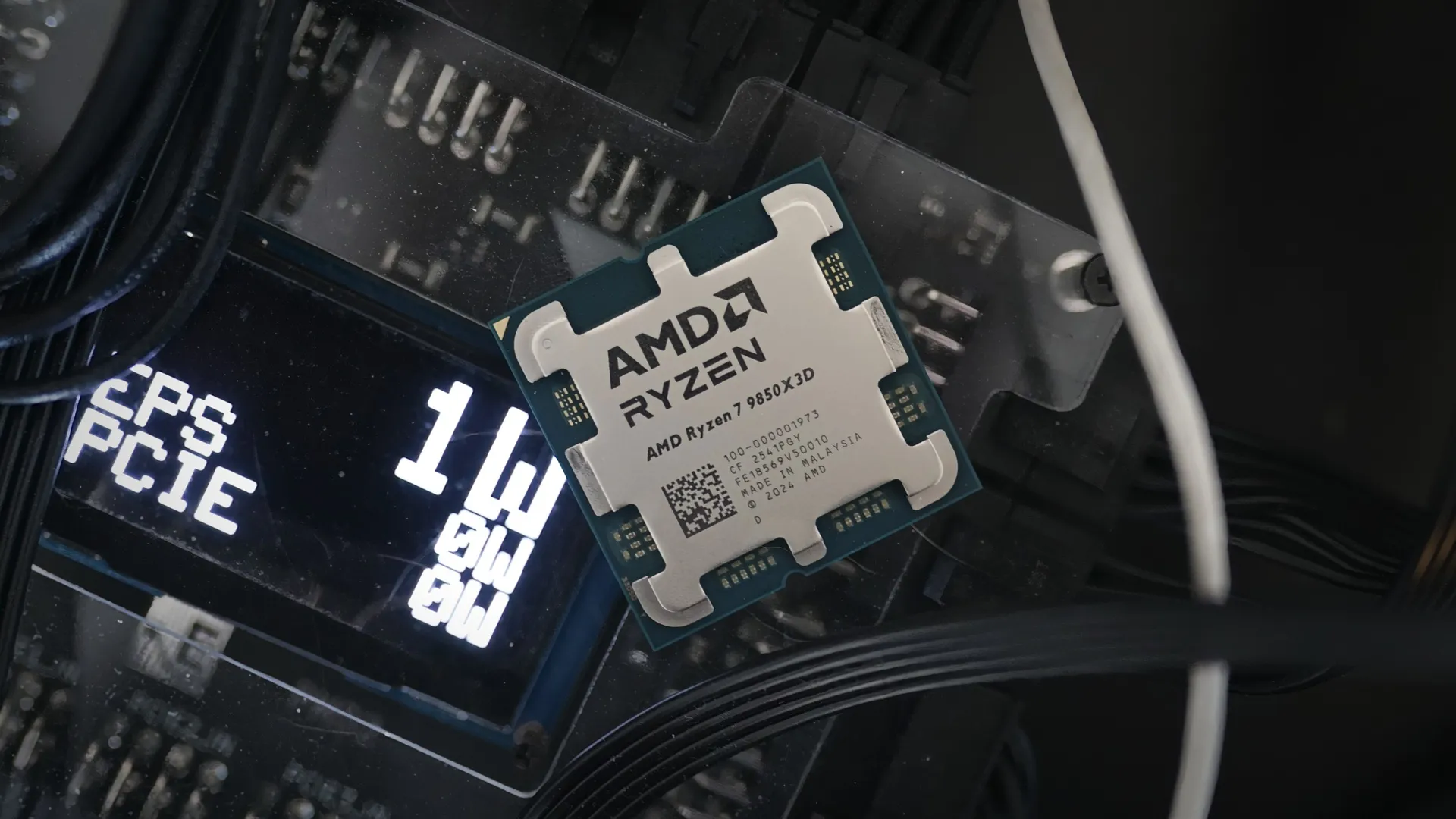
The AMD Ryzen 7 9850X3D CPU sitting on the PMD2 power tester.
(Image credit: 3DTested)

Both AMD and Intel said during the 2026 Morgan Stanley Technology, Media & Telecom Conference that demand for CPUs is seeing an uptick due to artificial intelligence. Intel CFO David Zinsner said during his question and answer (via Investing.com) that “the CPU has become cool again this year,” especially as AI agents need CPUs to orchestrate the computationally-heavy tasks that the GPUs and NPUs will execute. It has even started seeing customers who are looking at long-term agreements, ensuring that they’ll have a continuous supply of these chips needed to expand their operations. On the other hand, AMD CEO Lisa Su said during the same conference, “You know, we’re seeing a significant CPU demand, frankly, as a result of the inference demand picking up.” She also added later that “the CPU portion of the business has actually far exceeded my expectations in terms of demand.”
We felt the full swing of this crisis in the fourth quarter of last year, with pricing for RAM modules and SSDs continuing to rise through February 2026. What makes this worse than the GPU shortage is that it has a much wider impact. While the GPUs that were in short supply were mostly limited to desktop PCs and gaming laptops with a discrete graphics card, virtually every modern digital device — from consumer devices like smart TVs and smartphones to automobiles and industrial-grade equipment — needs memory and storage. And consumer-grade memory and storage is fighting for the same wafer space that enterprise-grade memory and storage could occupy, usually with a far higher price tag.

As AI advancements move forward from large language models and chatbots to agents that can observe, reason, plan, act, and learn independently, data centers require more multi-processor computing power — that means combining CPUs, GPUs, NPUs, and more — to support the entire agentic AI workflow. China is starting to see this spike in demand, with both Team Blue and Team Red reporting supply shortages for server CPUs in the region. We’re also seeing a spike in demand for high-end Mac Studios and Mac minis, especially as we see more people build their own local AI agents with the rise in popularity of the open-source Clawdbot/Moltbot/OpenClaw.

AMD and Intel are presumably talking about data center demand for their CPUs; consumer systems aren't equipped to handle the massive memory demands of agentic AI. If there is a shortage, however, it could trickle down to the consumer market, assuming the demand keeps pace.

Over the past several generations, AMD and Intel have converged their data center and consumer offerings, allowing them to maximize yields by leveraging the same microarchitecture across both client and enterprise. Some of that silicon won't be useful in the data center, so the consumer market won't evaporate. But it could put downward pressure on supply if the focus shifts toward the data center, as we've seen with RAM and SSDs.

Unlike Nvidia, which has seen exponential increases in revenue in its data center business, both AMD and Intel still see about half of their total revenue each quarter from the consumer market. It's still an important market, so although demand from data centers may increase, it shouldn't come at the cost of the consumer market, at least entirely.

Hopefully, both Intel and AMD can keep up with the future demand, so as not to exacerbate the worsening situation of the computer industry. Otherwise, some are already predicting the end of the entry-level PC by 2028 if things continue as they are.

Google Preferred Source

Follow 3DTested on Google News, or add us as a preferred source, to get our latest news, analysis, & reviews in your feeds.

Jowi Morales
Contributing Writer
With contributions from
  • Notton
    Yeah, but which type of CPU?
    Desktop? Laptop? HEDT? Server?
    Reply
  • Fabid
    Well, is it really due to to agentic AI?

    The support of Windows 10 has also officially recently ends, which mean that some people have to buy a new computer to not be exposed to threads. In addition, there is rumours that "Windows 12" would require 40 TOPS and seem people will try to reach this to be able to shift to W12 when it releases.

    Note, that the available CPU lineups with 40 TOPS are arguable (e.g. No current desktop AMD CPU with 40 TOPS and the future AMD AI 400 desktop lack GPU power). Intel seems to only reach the 40 TOPS on some of their mobile CPU when it is more frequent on the AMD mobile CPU. This mean that there is still a long way until every computer can reach 40 TOPS or that the most of the current sell CPU will very quickly be outdated (1-3 years?).
    Reply
  • DS426
    Intel's production capacity is already constrained.

    Oof.
    Reply
  • Blastomonas
    Feels like the golden years of PC building are well and truly behind us.
    Reply
  • DS426
    Fabid said:
    Well, is it really due to to agentic AI?

    The support of Windows 10 has also officially recently ends, which mean that some people have to buy a new computer to not be exposed to threads. In addition, there is rumours that "Windows 12" would require 40 TOPS and seem people will try to reach this to be able to shift to W12 when it releases.

    Note, that the available CPU lineups with 40 TOPS are arguable (e.g. No current desktop AMD CPU with 40 TOPS and the future AMD AI 400 desktop lack GPU power). Intel seems to only reach the 40 TOPS on some of their mobile CPU when it is more frequent on the AMD mobile CPU. This mean that there is still a long way until every computer can reach 40 TOPS or that the most of the current sell CPU will very quickly be outdated (1-3 years?).
    Taking a step back, TOPS should really be measured as a whole system, i.e. The sum of CPU + GPU + NPU (when existant); therefore, you simply get desktop "AI PC's" by requiring a dGPU if the iGPU doesn't get that number across the line. Not saying I want to see this as then already costly budget GPU's become even more costly.

    I think going forward, AMD and Intel will use those beefier NPU's as it'll ultimately help their margins in the long run if they can crank out more AI-certified PC's based on their products, whatever that badge is (Copilot+ or otherwise). This, not for all desktop CPU's but at least some, similar to how AMD has Ryzen 200 series mobile CPU's that only have 16 TOPS NPU's (and some don't have an NPU at all or it's fused off, effectively the same result). Ignoring how useful the features are today, having Copilot+ features on laptops but not on desktops doesn't look good from a marketing perspective.
    Reply
  • Fabid
    DS426 said:
    Taking a step back, TOPS should really be measured as a whole system, i.e. The sum of CPU + GPU + NPU (when existant); therefore, you simply get desktop "AI PC's" by requiring a dGPU if the iGPU doesn't get that number across the line. Not saying I want to see this as then already costly budget GPU's become even more costly.

    I think going forward, AMD and Intel will use those beefier NPU's as it'll ultimately help their margins in the long run if they can crank out more AI-certified PC's based on their products, whatever that badge is (Copilot+ or otherwise). This, not for all desktop CPU's but at least some, similar to how AMD has Ryzen 200 series mobile CPU's that only have 16 TOPS NPU's (and some don't have an NPU at all or it's fused off, effectively the same result). Ignoring how useful the features are today, having Copilot+ features on laptops but not on desktops doesn't look good from a marketing perspective.

    Yes, you could have an AI PC by using an dGPU. Now, the problem would be how the OS will estimate if you reach the 40TOPS and if your computer will still work if your dGPU get broken. This is why having a dedicated integrated NPU reaching at least the minimal TOPS requirement on the CPU would be wise (Not to say that NPU are also more efficient for AI tasks).

    Having Copilot+ features on laptops but not on desktops doesn't look especially good if the rumor of the requirement for windows 12 are true... Because it means that may-be only laptop would be able to run its (as not all dektops have dGPU).

    Now, AI are useful features but also dangerous features as lot of people do not understand how it works (linear regressions, principale component analysis, clustering, etc). If AI was introduced at the time where people believed the Earth was planar, AI would just have repeated it due to the existing database... Even if there was evidence that it was wrong.
    Reply
  • Gururu
    So confusing, I though AI needed GPUs not CPUs.
    Reply
  • Neilbob
    Does anyone else heave a gusty sign whenever these sorts of articles appear?

    Soon, there'll be no such thing as electronics for consumers because it'll all have been snapped up by iffy corporations. You need to actually possess a phone or computer in order for it to be infested with unwarranted A.I. Claptrap, so at least that'll be one less thing to worry about.

    Can go back to playing board games with the family, or playing Solitaire with actual physical cards like back in the 'good old days'.
    Reply