Stay On the Cutting Edge: Get the 3DTested Newsletter
Get 3DTested's best news and in-depth reviews, straight to your inbox.
You are now subscribed
Your newsletter sign-up was successful
An account already exists for this email address, please log in.
Subscribe to our newsletter
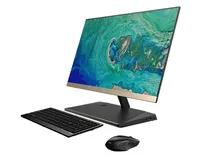
Acer announced that its slimmest all-in-one (AIO) desktop PC, the Aspire S24, is now available in the U.S.
The previously announced AIO is making its way stateside with a static configuration consisting of an Intel Core i5-8250U (Kaby Lake-R) processor with 12GB (1 x 8GB, 1 x 4GB) of DDR4-2133 memory (expandable up to 32GB) and a 1TB 5,400 RPM HDD housed under a 23.8” 1920 x 1080 active matrix TFT display. The chassis measures a mere 0.2” and is easily the company’s thinnest AIO PC offering.
The Acer Aspire S24 is aimed at the luxury crowd, boasting mainstream performance for daily tasks and entertainment (with a Core i5 and Intel UHD 620 Graphics) in an elegant chassis, putting aesthetics over acumen (especially in games) with a sleek black and rose gold finish. There's a 1.0MP front-facing webcam integrated with the bezel, and the base of the device is a wireless charging bay for Qi-enabled devices, letting users charge compatible mobile devices without an cables getting in the way.
Article continues below
USB connectivity is adequate for standard users, with three USB 3.1 (Gen 1) ports, a USB 2.0 port, and a USB 3.1 Type-C (Gen 1) interface. There's also an SD card reader. Additional displays can be connected via the two HDMI ports, and you can get on the internet via a gigabit Ethernet port or 802.11ac WiFi. The S24 is powered by a 135W adapter, comes loaded with Windows 10 Home 64-bit, and ships with a wireless keyboard and mouse.
The Acer Aspire S24 AIO PC is available now from the company’s website for $880 for U.S. Customers.
Acer Aspire S24 AIO Desktop PC
Stay On the Cutting Edge: Get the 3DTested Newsletter
Get 3DTested's best news and in-depth reviews, straight to your inbox.
AIOs are get the worst of both worlds. You are constrained by the form factor like laptop, can't really upgrade, expand, game etc., and you get the constraints of a desktop, heavy, big, no battery, and not portable. What possesses people to think AIO is a good idea to start with? A NUC at least makes sense with being so small and cheap, so the user is free to use it in any application they like, but tying a NUC down with a screen to make an AIO, all the goodness of the NUC is destroyed.