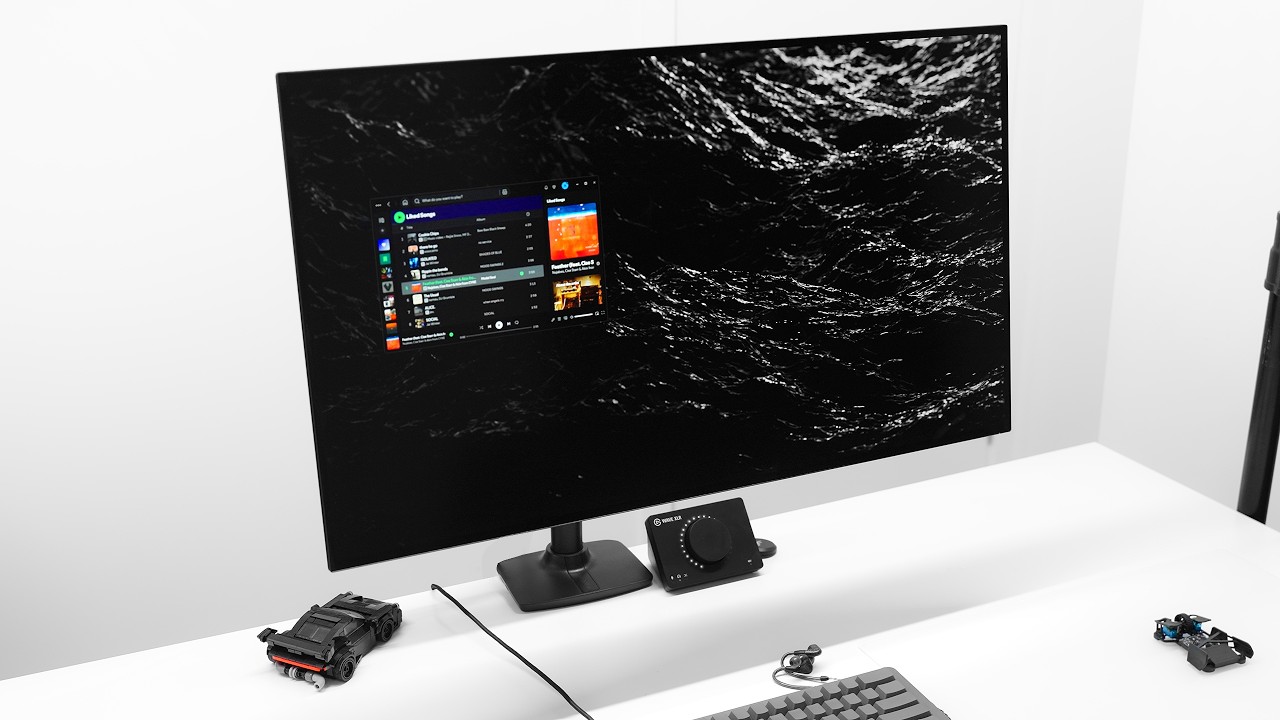
OLED gaming monitor shows only light burn-in after 3,000-hour torture test — 500 hours of Overwatch gameplay leaves a faint scar on the premium panel

OLED burn-in after 3000 hours of usage
(Image credit: optimum on YouTube)

Image retention, commonly known as burn-in, remains a major concern for prospective OLED buyers despite advances in countermeasures. The various benefits of self-lit pixels, such as infinite contrast ratio and instantaneous response times, are often overshadowed by longevity woes. This latest burn-in test from YouTuber Optimum shows that unless you're abusing your display, there's little to worry about.

For two years, Optimum has been using an LG 32GS95UE-B dual-mode 32-inch OLED monitor with native 4K resolution at 240 Hz, which can be doubled to 480 Hz at 1080p. He's logged over 3,000 hours on this bad boy, mostly playing Overwatch (2) and working on DaVinci Resolve and Fusion 360. All three apps have many static elements, so this should be a solid real-world test.

My OLED burn-in after 3000hrs. - YouTube My OLED burn-in after 3000hrs. - YouTube
Watch On

So, after all that wear, was there any burn in? The answer is yes, mainly from Overwatch, with close to 500 hours logged in the game. The health bar in the bottom-left corner was slightly retained and visible on a grey background, alongside the player card next to it. These dying pixels were very hard to notice, even on cherry-picked fullscreen colors, and Optimum had to edit the pictures to make them easier to see.

The only other burn-in was from DaVinci Resolve's scroll bars in the editing timeline, positioned at the bottom-right corner, but this was even less perceptible. There was no other sign of image retention across the screen, but the overall peak brightness dropped from 262 nits to 258 nits after 3,000 hours. That's still basically as good as new, a sentiment Optimum mirrored in his video.

This usage pattern was fairly realistic rather than the simulated stress applied to displays, as we've seen before with Rtings.com's testing. That's not to say those results aren't valid; if anything, roughing up these OLED screens better demonstrates how they'll hold up over time beyond their warranties. As such, Optimum even advises using the generous 3-year support window you get from most vendors these days if you notice burn-in.

Moreover, his routine included just one game and two apps, which would be a sort of torture-test scenario. If you're switching between different games and changing what's on your screen frequently, you're likely to see better results. At the same time, if you use snapped windows and don't hide your taskbar, those will be the first areas affected by image retention, likely before any in-app elements.

The video repeatedly states that slight image retention is not noticeable in everyday use, even if you look for it. That being said, the Overwatch bits burned-in were caused by an average of 30 minutes played per day, so if your playtime is higher than that for one specific game, there will be a heightened chance of burn-in.

Optimum ends the video by recommending keeping all the panel care features enabled, which we concur with, especially pixel refresh, which shifts individual pixels to help them wear down less easily. OLED burn-in is something that can never honestly go away — it's a byproduct of the tech rather than something conventionally "solvable" — so the best we can do is to be just a bit more careful with our expensive gear.

Google Preferred Source

Follow 3DTested on Google News, or add us as a preferred source, to get our latest news, analysis, & reviews in your feeds.

TOPICS
Hassam Nasir
Contributing Writer
  • JayGau
    That's very concerning actually. I play Call of Duty more than an hour a day in average. Which means that I could get burn-in by the end of the year?

    When I got an OLED in November, I really didn't think I would have to replace it on a yearly basis. Everybody was saying that if you only game and don't do office work all day long the monitor will last for years. But after two years of playing the same game as little as 30 minutes a day you get burn-in? And you report that as a good news?
    Reply
  • hotaru251
    JayGau said:
    y more than an hour a day in average. Which means that I could get burn-in by the end of the year?
    1hr x 365 = 365 hrs a yr.
    You'd have to play it like 8hrs daily to fit 3000 hrs in a yr
    Reply
  • A Stoner
    hotaru251 said:
    1hr x 365 = 365 hrs a yr.
    You'd have to play it like 8hrs daily to fit 3000 hrs in a yr
    The burn in was from 500 hours of playing a game. This guy says he games in a single game more than 365 hours a year, close to the 500 hours that gave burn in.

    So, he seems to be onto something.

    I work on my computer ~2000 hours a year and then play on it another 600 or so. Burn in would be a major issue to me if it happened faster than 10,000 hours, less than 4 years of use. And if one of my programs was likely to cause burn in in less than 500 hours of use... No way!
    Reply
  • JayGau
    hotaru251 said:
    1hr x 365 = 365 hrs a yr.
    You'd have to play it like 8hrs daily to fit 3000 hrs in a yr
    I said more than an hour a day (and that's a conservative estimation). I certainly reach in a year the 500 hours* that caused the burn-in in Overwatch.

    *The 3000 hours are for the total usage, the burn-in was caused by 500 hours of Overwatch (you don't even need to read the article, it's in the title).
    Reply
  • JayGau
    A Stoner said:
    The burn in was from 500 hours of playing a game. This guy says he games in a single game more than 365 hours a year, close to the 500 hours that gave burn in.

    So, he seems to be onto something.

    I work on my computer ~2000 hours a year and then play on it another 600 or so. Burn in would be a major issue to me if it happened faster than 10,000 hours, less than 4 years of use. And if one of my programs was likely to cause burn in in less than 500 hours of use... No way!
    Yes exactly!
    Reply
  • FoxtrotMichael-1
    I’m sorry, but this is actually terrible longevity for the OLED. To be honest, I can’t figure out how you guys could make this seem like a good thing - maybe a bit too much brainwashing by companies trying to sell you bad technologies for too long. First, I work on my computers - which means I’m easily logging 8+ hours a day on them. This means I’ll hit 3,000 hours in about a year. Not exactly a “torture test.” Secondly, I’m still using CRT monitors like my Commodore 1902A from the mid 1980s and they still work just fine. So I’d suggest you adjust your Overton window away from the modern consumerist mindset and realize that, actually, a monitor that will last a few years - at best - for power users is a terrible technology and extremely wasteful. I’ve never bought an OLED and this reminded me why I never will. The doublespeak about how this is such good news is just a bit disconcerting.
    Reply
  • A Stoner
    If nothing else, the OLED losing brightness is probably the worst part of the failure here. Burn in theoretically can be controlled by having refreshing sessions often enough to remove artifacts. So, unless the screen has to be showing the exact same image 24/7, there would be ways to avoid having significant burn in. But if the brightness deteriorates, there is really nothing to fix that other than if they have significant excess brightness built in that allows it to be boosted as it deteriorates. But that likely would come at a cost as the boosting likely causes more wear and tear on the materials making the light.
    Reply
  • JTWrenn
    Everyone has to pick what they want here for their own situation but for me, that is not long enough. Hell really...it would have be 5 years of 40 hours a week plus for me to consider it. I don't upgrade my monitor very often and while the oled look nice, any artifact like that would bother me personally.

    So for me I think oleds are just never going to be a thing, which is really frustrating. I would rather go for a monitor that is a bit lower on contrast, much cheaper, but I don't need to think about it at all. The specter of it possibly happening would probably drive me nuts.

    Oh well, just gotta pray for real full microled and hold the line.
    Reply
  • Shiznizzle
    I took possession of an Alienware AW2725DM today. Its a 27 inch, IPS, 1400p with HDR 400. None of this HDR Ready marketing speak garbage. Not HDR 1000 but at least its not HDR Ready or HDR 10. It has a certification at least.

    I was on 1080p for the last decade. If you are only accustomed to 1080p and then draw the no dead pixel/stuck pixel lottery like i did with that monitor, then that resolution will blow your mind. It did mine. Unbelievable.

    I had to learn over the last 2 weeks about monitors. One thing i knew already. No OLED for me. I knew about burn in. No way. I cant afford a new monitor of a few hundred every two years. They have to keep working.

    My BenQ 2222 HDL had 55.000 hours. Not a dead pixel in sight. It was a TN TFT LED. That is now my second monitor.

    More than %40 of monitor sales today are the good ole LCD backed by LED lighting. IPS panels mostly. There is a reason for that, i think. People do not want to fork out for OLED's. I dont.

    OLED's are far easier to manufacture and are far less complex than the current VA, IPS and TN panels though, so there may come a time where no other panel will be for sale. My guess is when they "solve" the burn in issue.

    Till then its either TN or IPS for me.


    Reply
  • SunMaster
    You guys thinking this is terrible should check out rtings longevity burnin test to get som perspective on different tech and burnin issues.

    Https://www.rtings.com/tv/tests/longevity-burn-in-test-updates-and-results
    Reply