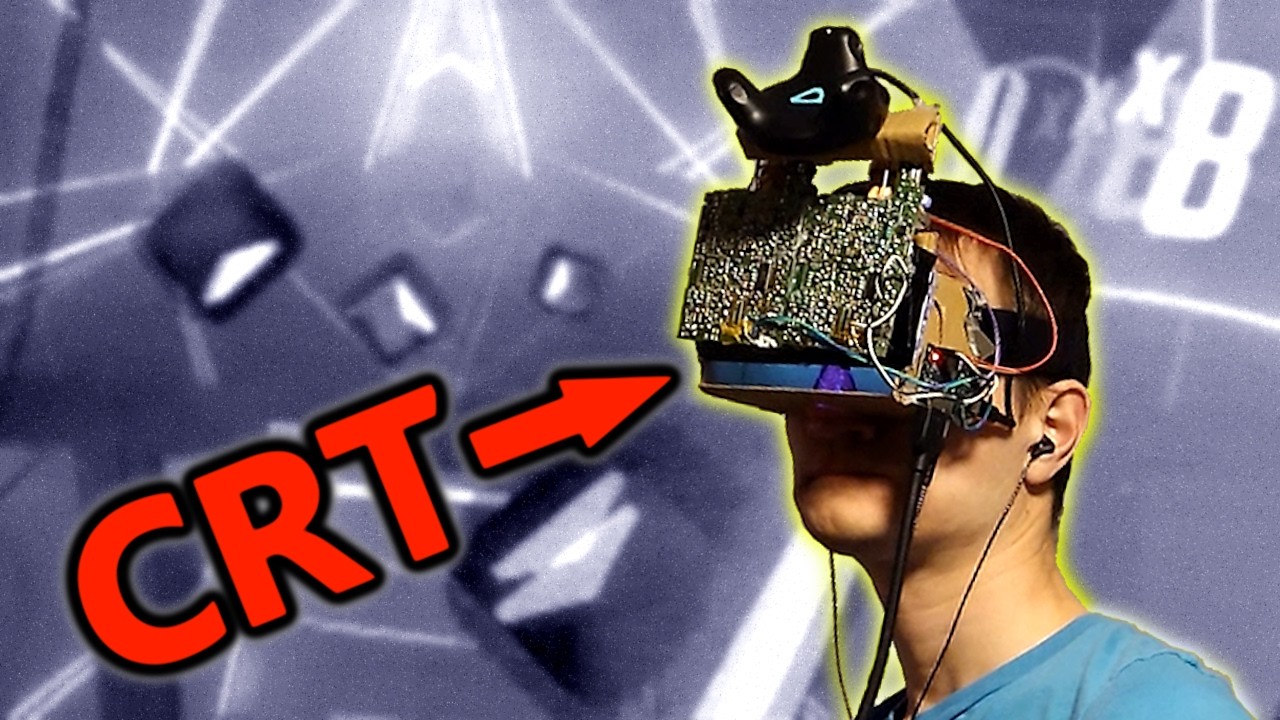
Virtual reality headsets come in all sorts of shapes and sizes, and the technology has matured enough to even become accessible for budget buyers. But what if you wanted something a little more unique that simply doesn't exist on the market? That's the predicament the aptly-named YouTuber 'dooglehead' found himself in when he wanted to enjoy the glory of cathode-ray tubes blasting directly into his eyes.

This makes the assembly much more compact, which is great for a VR headset, but it's limited to black and white reproduction only due to shadow mask constraints. The Watchman displays also don't have any composite input, so dooglehead whips out an FPGA dev board and devises his own HDMI input. Through some programming, he makes the CRT appear as an external monitor connected inside Windows.
Now comes the fun part, figuring out the tracking for the headset. Our enthusiast follows one of many DIY VR headset projects hosted on GitHub and starts building out his own tracking system. He creates a custom PCB with an IMU for rotational tracking, the aforementioned HDMI port, and two USB-C ports — one for powering the CRTs and one for connecting an HTC Vive tracker.

To enable positional tracking, lighthouse base stations firing infrared laser beams were placed in the corners of the room and sweep it thousands of times per second to detect movement. If the laser hits the photodiodes in a VR headset, those SteamVR lighthouses can precisely triangulate where you are in the space.
Since dooglehead's makeshift contraption obviously didn't have the constellation of tracking points of a Vive or Index, he had to resort to using an external tracker. Everything was put together on a rather dangerous-looking Google Cardboard chassis, with the custom PCB, the FPGA, the CRT screens, and an HTC Vive tracker just strapped together with hopes and dreams. The entire thing weighed only 544 grams, which is lighter than some actual retail headsets.

The project itself doesn't go any further with a 3D-printed shell or other refinements because according to dooglehead, the resulting CRT VR headset was not the most impressive thing ever. The YouTuber includes a 3-minute gameplay segment going through various VR titles that include driving, shooting, role playing, and more, while showing the CRT screen in action. It looks exactly like you'd expect — a greyish luminescent image with some character.
Dooglehead's first comment was that he wished the screen was in color because in some games it made it hard to distinguish between certain elements. Secondly, the screens felt blurry: not due to the 640x480 (per eye) resolution, but because the electron beam wasn't perfectly in focus. The fact that it was then hitting the screen at a perpendicular angle just exacerbated this issue.
The biggest positive to using the CRTs was the lack of screen door effect (SDE) since they have a natural anti-aliased look that blends pixels to its advantage. VR screens are especially susceptible to SDE, since they're so close to our eyes.

The YouTuber closed out the video by saying he won't switch to this DIY CRT VR headset mainly because he prefers a color screen. He was glad to have experienced this mashup of retro and modern tech, but it's simply too outdated to use on a daily basis. CRT shaders can likely emulate a similar look, and manufacturers keep shipping insanely high-res displays on VR headsets these days that combat the SDE. But we have to commend dooglehead for seeing this crazy idea all the way through to the end.

Follow 3DTested on Google News, or add us as a preferred source, to get our latest news, analysis, & reviews in your feeds.