Rumors about a missing hardware link between the Sega Saturn and Dreamcast have swirled mysteriously for many years. Now, thanks to a series of interviews published by Japan’s Beep21 gaming magazine (machine translation), the truth is out. An ex-Hitachi, ex-Sega, and ex-Sony engineer has confirmed that he proposed and developed a Saturn graphics accelerator, codenamed TRIP, based on Hitachi’s SH‑3 processor.
The Sega Saturn console launched in late 1994 / early 1995, as Sega’s fifth-generation machine, going up against Sony’s first-generation PlayStation. Sega became concerned about leaks pointing to great PlayStation (PS One, PSX) performance. So, a few months before the launch, it reconfigured its Saturn with an extra Video Display Processor (VDP). Thus, the machine ended up with ‘processor soup’ made up of dual Hitachi SH-2 (28 MHz) RISC processors, two VDPs, plus co-processors dedicated to 3D geometry, sound, and I/O.
With its previous-gen console, the Genesis (AKA Mega Drive), Sega didn’t hold back from iterating with the Mega-CD, 32X, Sega Channel network, and more. But rumors about an accelerator for the Saturn came and went with no hardware ever released, nor revealed, until now.
Article continues belowTRIP accelerator with SH-3 processor
The missing link between the Saturn (1994) and Dreamcast (1998) was an accelerator for the former, internally known as the TRIP. Beep21 heard about this elusive project from an engineer called Junichi Naoi.
According to the source story and interview, Naoi was a Hitachi engineer who was in the team that developed the SH-1, SH-2, and other CPUs and ASICs. For the SH-2, he implemented several Sega-requested enhancements into the design. However, in 1994, Naoi would join Sega and help the firm develop cost-optimized revisions of the console over its lifecycle.
In 1996, a couple of years after Saturn first hit the market, and a couple of years before the Dreamcast would splash down, Sega felt that its current console was losing its shine. Not only was the PlayStation 1 doing amazingly well, but 3D accelerators were starting to establish PCs as very capable modern gaming machines.
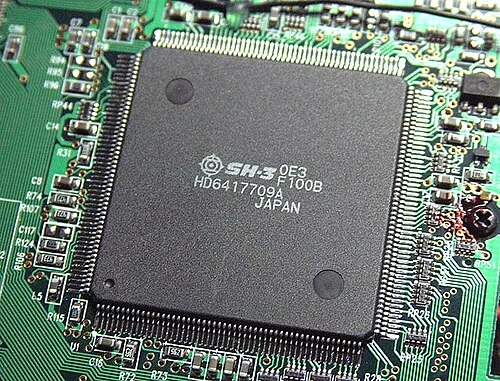
Thus, the TRIP project was born at Sega. The proposed accelerator module for the Saturn would include a Hitachi SH-3. This chip was expected to significantly boost graphics and geometry calculations on the Saturn. According to the report/interview, the TRIP was judged to be good enough to propose that future Dreamcast classics Virtua Fighter 3 and Shenmue be launched alongside it.
Development work on TRIP and those launch titles went ahead, but the project was abruptly cancelled. We don’t know much about why, yet. Reasons could have included development wrinkles, costs, timing, or a combination of such issues. Nevertheless, a prototype TRIP board was made, and Shenmue assets were rebuilt for it before it was culled.
The engineer would Sega, and corporate knowledge of TRIP evaporate
Naoi went on to join Sega’s arcade development division, but left for Sony to contribute to the PS3 era. As one of the few contributors to the short-lived, quietly cancelled TRIP project, knowledge of the Saturn accelerator among fellow Sega alumni basically evaporated.
Sega’s Dreamcast arrived in 1998 with yet another generation of the Super Hitachi (SH) chip, the SH-4. Overall, the new console's architecture was far simpler, with this single fast (400 MHz) RISC CPU, and an NEC PowerVR2 GPU, augmented by a Yamaha sound chip.

Follow 3DTested on Google News, or add us as a preferred source, to get our latest news, analysis, & reviews in your feeds.