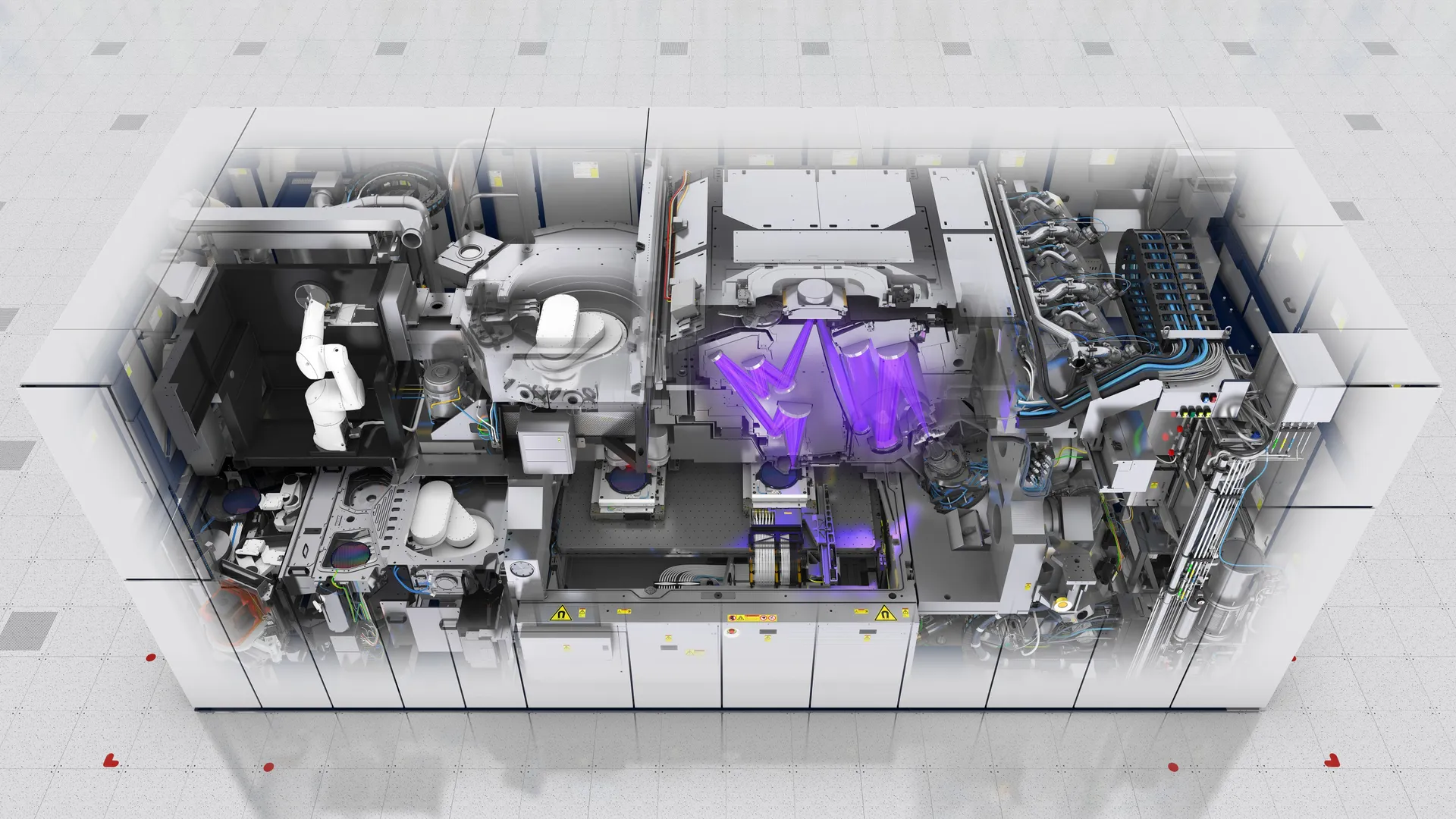
ASML this week reaffirmed that it is on track to release a Twinscan NXE extreme ultraviolet lithography system that features a 1000W EUV power source and can process up to 330 wafers per hour. The system, projected for sometime in 2030 or beyond, offers 50% more power than the current best EUV tool, the NXE:3800E. Such machines will greatly decrease productivity and decrease costs per wafer for chipmakers, but to make them possible, ASML has had to achieve several breakthroughs.
"What was achieved — one kilowatt — is pretty amazing," Michael Purvis, ASML's lead technologist for its EUV source light, told Reuters. "We see a reasonably clear path toward 1,500 watts, and no fundamental reason why we couldn't get to 2,000 watts."

Installing a new tin droplet generator with twofold performance, as well as building a new CO2 laser system that doubles the number of light pulse sequences, sounds easy on paper. However, both these devices, as well as devices that accompany them to make their work possible, represent a major technological breakthrough.
Increasing the number of tin droplets automatically means increasing the amount of debris that can end up on a wafer (or rather a pellicle), which must be promptly removed, requiring an all-new debris collector. While producing 1000W of EUV radiation is hard, transferring it onto a wafer is even harder, so ASML had to invent all-new high transmission projection optics, which have already been deployed with the NXE:3800E and which are meant to scale all the way to over 450 wafers per hour, or toward something like 1500W. Last but not least, a 1000W EUV light source also calls for new resists and pellicles, so in addition to ASML itself, the whole industry needs to prep for the arrival of the company's tools featuring its latest innovations.
ASML has long planned to increase the productivity of its EUV lithography scanners to 330 wafers per hour by around 2030, a productivity level tied to a 1000W light source. Therefore, the announcement made this week outlines the technology the company invented to achieve that roadmap goal.

ASML is yet to integrate its 1000W EUV light source into its Low-NA EUV and High-NA EUV roadmaps. The company's next-generation Low-NA Twinscan NXE:4000F litho system with a production capacity of over 250 WpH and a matched machine overlay (MMO) performance of 0.8 nm for 1.x-nm-class nodes is due in 2027, followed by the NXE:4200G with productivity of over 280 WpH in 2029. On the High-NA EUV front, ASML preps the Twinscan EXE:5200C with an over 185 WpH output and a <0.9nm MMO performance next year, followed by the EXE:5400D with productivity of over 195 wafers per hour in 2029.

Follow 3DTested on Google News, or add us as a preferred source, to get our latest news, analysis, & reviews in your feeds.