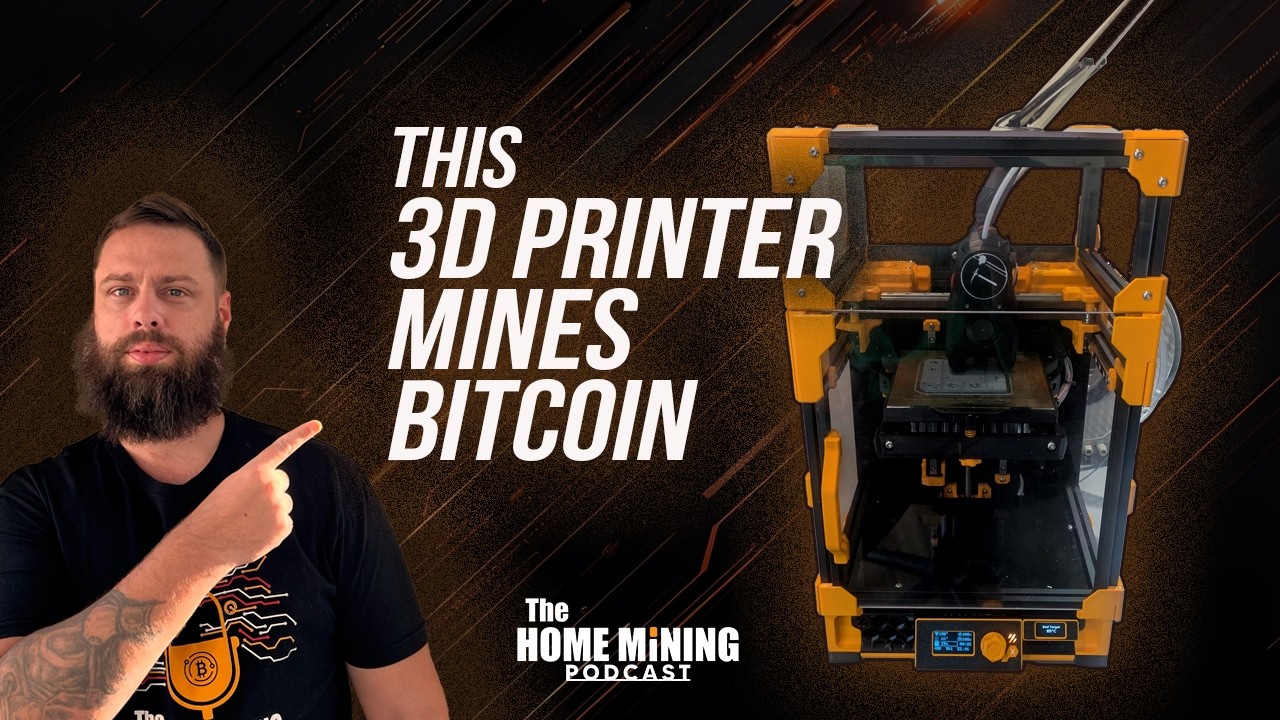
The creator of a 3D printer that mines Bitcoin took part in an interview on the Home Mining Podcas t over the weekend. Host Two Sats quizzed creator PizzAndy about his adapted 3D printing prototype. In summary, the hybrid device is based on an open-source 3D printer design with a custom bed that is heat-controlled by throttling the Bitcoin mining ASICs attached to it. Yes, the printer bed is basically a heatsink. The compact prototype is capable of a humble 500 GH/s, says PizzAndy, but there are already plans for scaling and a tile-based model using Intel ASICs targeting at least 10 TH/s.
Then, in 2024, PizzAndy attended a presentation about heat reuse — and something clicked. The 3D printer/BTC enthusiast thought it would be “a cool thing” to mix these two technologies, but wasn’t sure about its commercial value. Since that time, he has become convinced that a commercial product is worthwhile.
Podcast host Two Sats advises his guest that this kind of hybrid product has to be top quality, a respectable performer in its field, with Bitcoin as a bonus. Then the pair discusses the recent emergence of easy-to-market home heating products, which are dual-purpose Bitcoin mining hardware.

Round the clock business
PizzAndy notes that “this product is mostly intended to exist in a print farm, where printers are printing around the clock, all the time… that’s when the economics of a print farm are not unlike a Bitcoin mine. And if your machines aren’t printing, you’re not making money.”
My 3D Printer mines Bitcoin. Jealous? 😏 pic.twitter.com/UW372UsRF3 February 1, 2026
Learning about the prototype
Andy says that the prototype achieves 500 GH/s when the bed is at 75 °C. The bed temperature is important to the process, so the BTC mining chips are run to target this particular thermal environment. This contrasts with typical BTC Miner optimization.
At this time, PizzAndy notes that the miner chip waste heat isn’t used to heat the extruder – only the 3D printer bed at this time.
Inside the prototype are four ‘BM 1362 AK chips’ according to the podcast transcript. A custom heatsink attached to these chips directly warms the bed. “That’s the heart of this printer, and its mining,” explains PizzAndy.
An open source printer design (Voron) forms the bones of this project, but Andy “designed everything on the Z-axis” with some supplementary electronics on the back. The ‘Bitcoin orange’ filament flourishes are the chef’s kiss of the design.


Roadmap and scaling
PizzAndy talks about a modular bed tile, which means you can scale up your printer bed and mining operation “as big as you want, theoretically.” Work on this is about to start, and the creator reckons there will be 16 mining chips per tile.
The mining hash rate of the new tiles at 75 °C is still to be determined, but estimates fall roughly between 10 and 30 TH/s with Intel BZM2 ASIC chips. “At least 10 TH/s or we riot,” quips Andy. And he teases there will be a prototype “soon.”
Interestingly, there is a configuration/efficiency perk of using cryptomining ASIC arrays to warm your 3D printer bed. Andy points out that you can selectively heat up certain zones of the printer bed, as each chip/tile is individually addressable. Also, different parts of the bed can be set to different temps to suit a range/mix of materials.
It will be interesting to see if this project takes off, or at least whether the bed tech gets bought/adopted by some of the bigger names in 3D printing. In essence, the underlying concept is like some of the Bitcoin water and space heater consumer products we’ve seen before.

Follow 3DTested on Google News, or add us as a preferred source, to get our latest news, analysis, & reviews in your feeds.