Should you splash out on those upgraded audio cables to take your music listening pleasure up a notch? Probably not - affordable Amazon Basics RCA cables are more than good enough - confirms audio TechTuber Amir from Audio Science Review. This won’t be a surprise to regular readers. However, it is interesting to see Amir’s $7 vs $4,000 cable analysis using scientific audio equipment – as well as drawing from his personal music listening experience.
RCA has been around since 1919
Amir compared the above stereo audio RCA cables. These are mostly used to link Hi-Fi components. Some PC sound cards and breakout boxes will feature them, as will some home video devices. The RCA standard dates back to 1919, so it is over a century old, and audio enthusiasts connecting older analog gear like certain amplifiers, turntables, and legacy components will make most use of these cables. Due to this, RCA will probably be supported for another few decades in its strongest current niches, like Hi-Fi.
Physical comparison
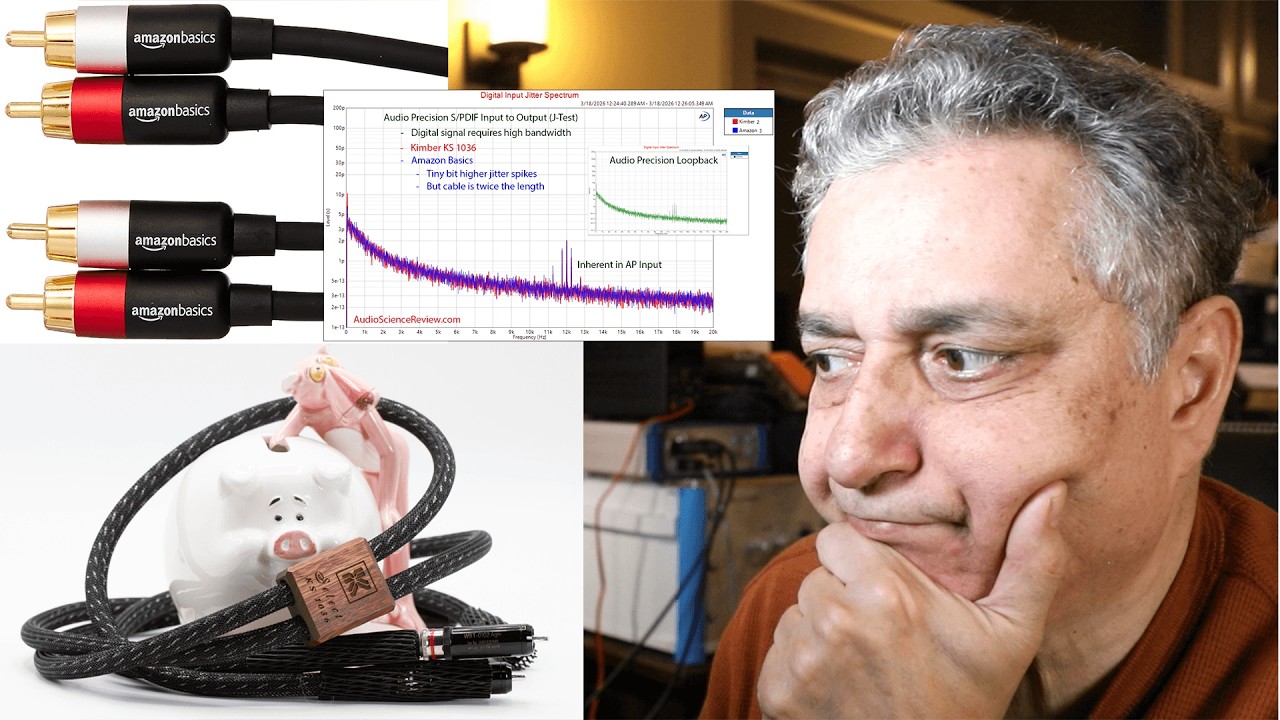
Back to the $7 vs $4,250 RCA comparison and what we have pitted against each other here are the Amazon Basics 2 RCA cables, 4ft in length, that are actually on sale currently at $6.76 (and up to 15ft in length for $8.96). In the other corner, there are the Kimber Kable KS 1036 Select Series Analog Interconnect (Pair), which we can see at Safe and Sound (US) in 1m (3.3ft) length for $4,100.
Article continues belowAmazon promises “crystal clear audio [and] reliable performance [with its] gold plated connectors.” However, the Kimber product aims for premium with its “Black Pearl solid silver conductors drawn in diamond coated dies and insulated with virgin FEP dielectric under the most exacting tolerances which offer the purest transfers of the most demanding highest resolution signals.” It should hardly be a fair fight.
Our host, Amir, noted that the Kimber product gets off to a bad start, with a totally unnecessary flight (Pelican) case. Indeed, it looks very cheap compared with the cable’s prestige target market.
Probably worse for the expensive product is that its locking cable design throws up as many negatives as positives. Basically, locking isn’t a particularly attractive feature here, and could precipitate accidental damage with someone unfamiliar with (or who forgets) the locking mechanism. Making this worse is the observation that inside the connector are “flimsy plastic tabs,” which is an inferior design feature vs traditional RCA cables.

Audio signal analysis
Amir then shifted to scientific audio analysis using Audio Precision analyzer hardware. Is this where the $4,000 cables would at last show their superiority?
Using a constant 4 KHz sine wave transmitted through the cable, a tiny bit of distortion was observed with both cables. There was actually a bit more mains power noise seen with the Kimber cable, but “practically speaking, the two are identical,” Amir said, pondering over this first set of metrics.
Next, we saw the cables exhibit identical response across a very wide frequency range. There was no phase difference seen in the tests. Same with the square wave rise response graph. Even a hugely magnified graph from the Audio Precision analyzer shows that these two cables performed identically.
Last but not least, Amir moved on to comparing jitter spectrum profiles in a bandwidth stress test. It was shown that the Amazon Basics cable shows a slight (picoseconds) increase in jitter. However, our host noted that the cheaper cable was noticeably longer than its boutique rival. And it would cost a lot extra to get one to match the Amazon alternative’s length.

Prestige RCA cables simply unnecessary
The results weren’t unexpected, but from around 13 minutes into the video, Amir explains why no one should be surprised that audiophile RCA cables aren’t worthwhile.
Competent cables like the Amazon model and better have “the lowest noise, lowest distortion, and widest bandwidth of anything in your audio system,” says the audio TechTuber. It isn’t a weak or sensitive part of the signal chain, prone to issues, and audio signals don’t push the ‘capacity’ of RCA cables, so there is little point in investing above a competent standard product like the Amazon Basics.
“Everything else in your system is the bottleneck,” Samir underlines, as far as quality is concerned. He likens the Hi-Fi audio signal chain to two cities connected with a 100-lane freeway (the RCA cables) – traffic problems are in the city, not on the freeway, he says.
To conclude, Amir admits to perceiving differences between cables when enjoying music, but puts the human experience down to feelings, mood, focus, and so on. When actually being clinical about A/B testing – like blind testing, etc - such differences evaporate, suggests the experience of this audio TechTuber.

Follow 3DTested on Google News, or add us as a preferred source, to get our latest news, analysis, & reviews in your feeds.