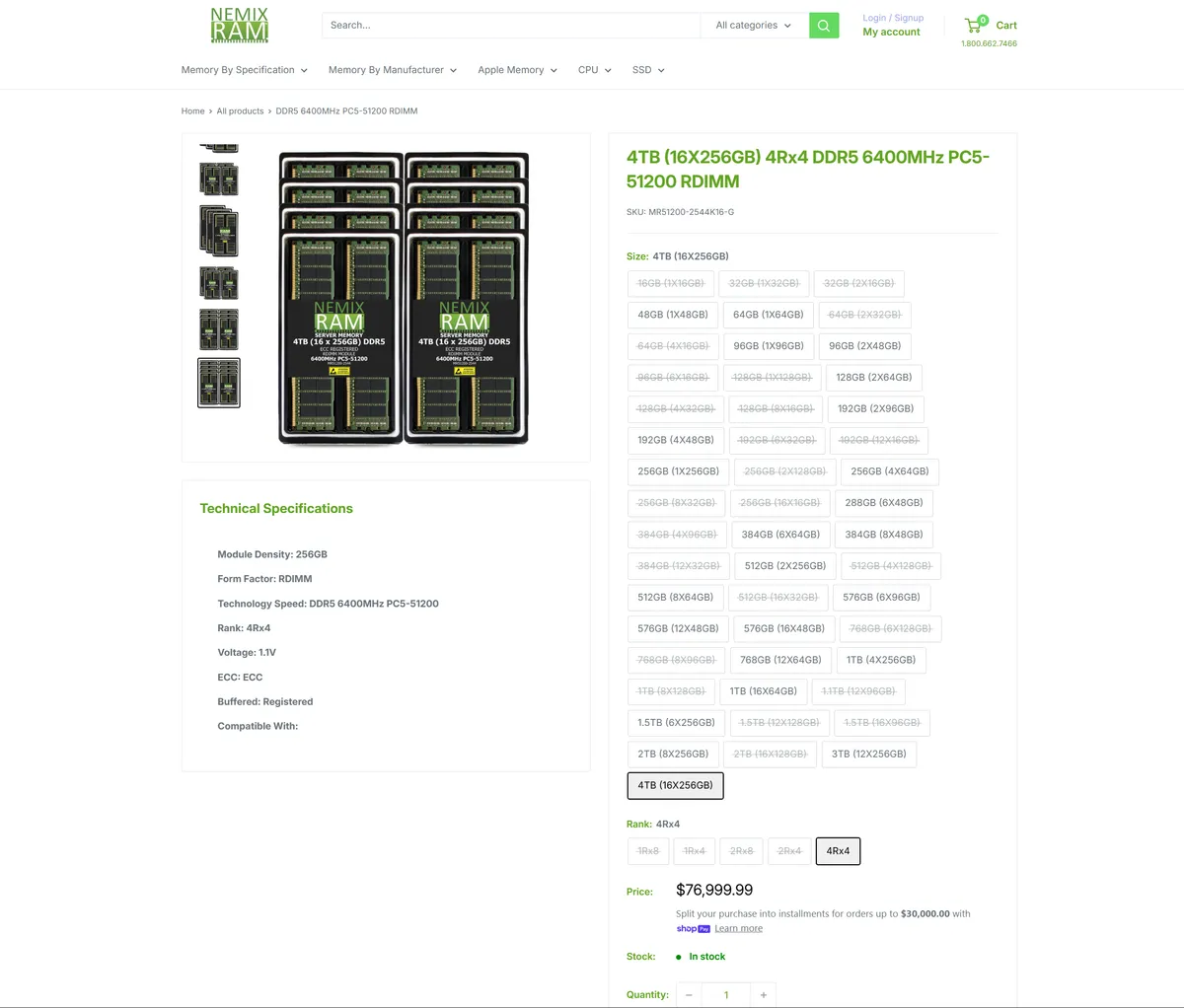
You can now buy 2 terabytes of DDR5 server RAM for the low price of just $39,000, and 4 TB for $77,000 — Nemix offers chart-topping capacities amidst an industry shortage
It just keeps getting better.
Get 3DTested's best news and in-depth reviews, straight to your inbox.
You are now subscribed
Your newsletter sign-up was successful
If it was becoming too easy for you to navigate the ongoing DRAM shortage, there's another entry on the leaderboards for the most expensive memory you can buy. Nemix, an American company, has just listed a whopping 2 TB of DDR5 ECC RAM on Amazon for $38,999, while you can also find the same sticks in a 4 TB configuration for $76,999.99 on Nemix's website.
Spec-wise, you're looking at four kits of 2 x 256 GB sticks for two terabytes — 512 GB per box, eight sticks total — and eight kits of 2 x 256 GB sticks for four terabytes, running at 6400 MT/s with a CAS latency of 52 across both configs.
Nemix offers a lifetime warranty on these, but a quick Google search shows mixed online reviews, which should weigh on a customer's decision if they're spending this amount on memory. Regardless, the prices are still the main highlight here.


You don't need us to tell you that's car money for server RAM. You can get a Ford Mustang in lieu of that 2 TB setup, or a Tesla Model S instead of the 4 TB option. Even before the current component crisis, server memory has always been more expensive than standard desktop memory because it's registered and error-correcting (ECC), which makes it RDIMM rather than UDIMM.
See, in normal DDR5 RAM that we use in our gaming computers, bit flips occur rarely, but they're mostly harmless beyond a crash. Servers can't afford that; they need the utmost stability, so they choose ECC memory that can actively correct single-bit errors on the fly. The sticks also have an extra buffer chip sitting between the memory and the CPU which helps reduce the load on the latter, and allow for higher capacities.
Therefore, server memory is fundamentally still DDR5, still using the same modules, but it's different enough to warrant the added cost. You've been able to purchase high-capacity DDR4 server RAM for some time. We found Nemix's own 2 TB kit for $13,468.89 on Amazon, which was only hiked by around $6,000 in the past few months. Relatively generous, if you consider the rest of the market.
The DDR5 RAM we're highlighting is new, though, as it landed on Amazon just 29 days ago, when it was $32,997 at the start, then $34,012, and finally $38,999 today, when it was spotted by @FanlessTech. Over the past month, even this kit has experienced a similar ~$6,000 increase.
Get 3DTested's best news and in-depth reviews, straight to your inbox.
We should point out that you can build a Mac Studio cluster with 2 TB of RAM for around $50,000, so this might actually not be a great deal depending on who you are. However, if you're running a server and need this kind of pool, you're already past being shocked at these prices. The world moves differently up there.

Follow 3DTested on Google News, or add us as a preferred source, to get our latest news, analysis, & reviews in your feeds.

-
Mindstab Thrull Some quick math:Reply
2 TB for 39k = 1 for 19.5 = 512 GB for ~9800 = 128 GB for 2450 = 32 GB for ~615.
(That's how my brain breaks down the steps to eventually get to numbers most people would use.)
IDK about ECC memory pricing but I'll wager a big chunk of the price is just the capacity of each module. A quick scan at PC Part Picker suggests a single stick of 32GB starts around 300ish and goes up from there, hitting around the 400 range pretty quickly. You're also looking at 256GB sticks which haven't exactly made it to consumer-level yet. So yeah, given current landscape, capacity, ECC, etc, this feels not absolutely silly. -
Li Ken-un ReplyWe should point out that you can build a Mac Studio cluster with 2 TB of RAM for around $50,000
…without ECC.
RemindMe! -20 yearsUsertests said:This capacity will cost $200-400 in 20 years. -
teeejay94 Based on some simple math that I likely got wrong, at the time I purchased my 32GB of DDR5 for 150$, 2TBs of the same should of cost around $5K, these price hikes should be illegal, again, my math could be way off but the point is that exorbitant price hikes should be absolutely illegal, how can any of you comfortably sit by with anything going from $100 to $1000 over night. Again, either understand my point or move on this isn't a debate for you to correct me my point remains and stands, exorbitant prices should be made illegal and price caps need to be placed on things like ram kits, 32GB of ram can only ever go up to say even 300$ maximum. But you know what that gets in the way of record profits and it becomes too difficult, anything that leads to making less money is always more difficult, making legislation for companies to rake in billions more is somehow easier than creating legislation for regulation. Who would of thunkReply -
technovelist Or you could buy Optane pmem on ebay for about $500/TB (https://www.ebay.com/itm/197906502972). Add a 2-socket server with Intel Xeon 8260L (~$2k maybe) and 64 GB of DDR4 DRAM (~$600) and put the Optane in memory mode and you could end up with about 6 TB of somewhat slower RAM for under $10k fairly easily.Reply -
jeremyj_83 Reply
Optane pmem is a dead technology, needs application support for non-volatile, is much slower than DRAM when used in the volatile setup and still needs at least 1/4 the system RAM to be DRAM for caching.technovelist said:Or you could buy Optane pmem on ebay for about $500/TB (https://www.ebay.com/itm/197906502972). Add a 2-socket server with Intel Xeon 8260L (~$2k maybe) and 64 GB of DDR4 DRAM (~$600) and put the Optane in memory mode and you could end up with about 6 TB of somewhat slower RAM for under $10k fairly easily. -
technovelist Reply
I guess that depends on your definition of "dead technology".jeremyj_83 said:Optane pmem is a dead technology, needs application support for non-volatile, is much slower than DRAM when used in the volatile setup and still needs at least 1/4 the system RAM to be DRAM for caching.
You can still buy as much Optane pmem as you want unless perhaps you are Oracle or Google. It has an almost unlimited lifespan in use and the hardware to use it is reasonably inexpensive and readily available on ebay.
I'm referring to using it in memory (volatile) mode, which is quite transparent as you probably know. BTW, minimum system DRAM for caching is 1/16th, not 1/4, of the pmem capacity.
Of course I'm not saying it's an ideal solution, but it is a solution for many people who don't have many other choices at present. -
jeremyj_83 Reply
It literally isn't being developed and IIRC Intel stopped supporting before Ice Lake Xeon or with Ice Lake Xeon.technovelist said:I guess that depends on your definition of "dead technology".
Yes you can do 1/16 but best practice and performance is 1/4. I did look into this a few years ago to upgrade the data center I run.Technovelist said:BTW, minimum system DRAM for caching is 1/16th, not 1/4, of the pmem capacity.