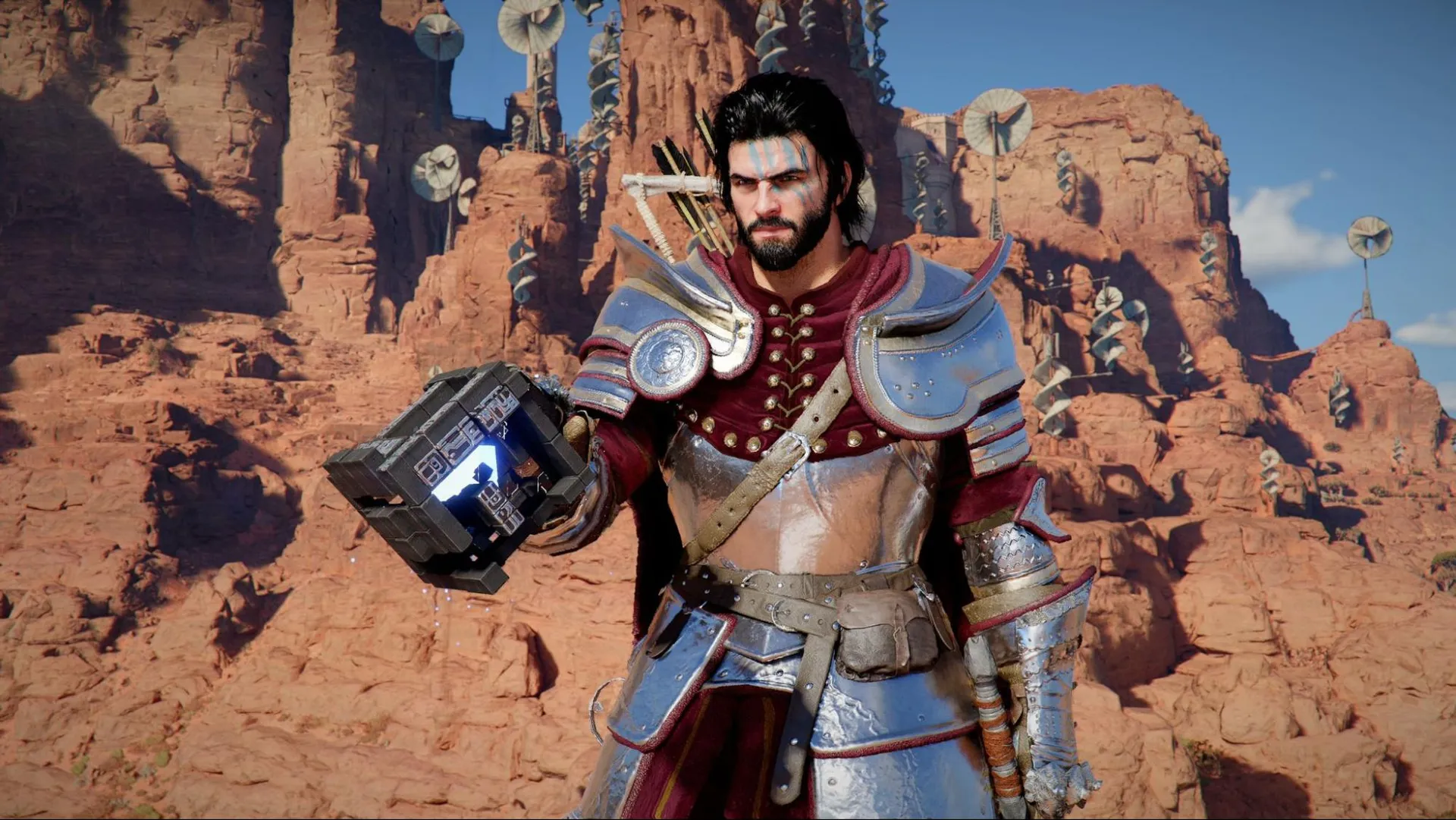
Crimson Desert is the type of game that shouldn’t ever see the light of day. Built originally as a prequel for popular MMO Black Desert Online before being scrapped and redirected to a single-player release, and sitting in development for close to a decade, Crimson Desert could have easily died in development. Add on top of that a proprietary game engine called BlackSpace, a modest headcount, and no external publisher — Crimson Desert defies the narrative about how AAA games are built and released today. But we’re here. Crimson Desert is real, it’s massive, and I’ve been poking around Pywel with the best CPUs for gaming to see how they react.
The results are positive. I mainly tested on the last few generations of AMD and Intel chips, though I threw in a Ryzen 7 2700X (just above the game’s minimum-spec CPU) and a Core i3-13100F (a weak quad-core chip) into the mix to see how they'd hold up. Unfortunately, I wasn’t able to get to as many older AM4 chips, due to time and some bent pins. It’s been a while.
Otherwise, Crimson Desert sets up a platonic ideal of how CPUs should scale in a modern game. Everything falls in line the way you’d expect, which is surprisingly rare to find in recent games, especially close to launch. You won’t find a performance wall like what we saw in Resident Evil Requiem, nor get the ever-present oddity of AMD’s eight-core offering outperforming its 12-core one.
Article continues belowThat doesn’t mean everyone is going to have a great experience. Although Crimson Desert ran well enough with a quad-core chip, it can certainly leverage a higher core count. And older architectures like Zen+ struggle, though that shouldn’t come as a surprise.
I ran through 20 CPUs, but I also played the game myself to uncover any strangeness in this unique engine — and there is some. Overall, however, Crimson Desert is an enigma. It shouldn’t work as well as it does given its dense systems and overwhelming landscape, but developer Pearl Abyss was able to stick the landing.
CPU Scaling in Crimson Desert
For testing, I used the RTX 5090 FE to isolate CPU performance as much as possible. Naturally, the numbers change when looking at a weaker GPU, but we’re looking at the overall trend in performance across chips here more so than the numbers themselves. I tested at native 1080p without upscaling or frame generation — Crimson Desert supports both in DLSS and FSR flavors — and with the Ultra preset and ray tracing disabled. There’s a further Cinematic preset that pushes the engine’s capabilities to the max, though for only a small visual payoff. Even on my personal PC with an RTX 5080 and Ryzen 9 9900X, I stuck with the Ultra preset.
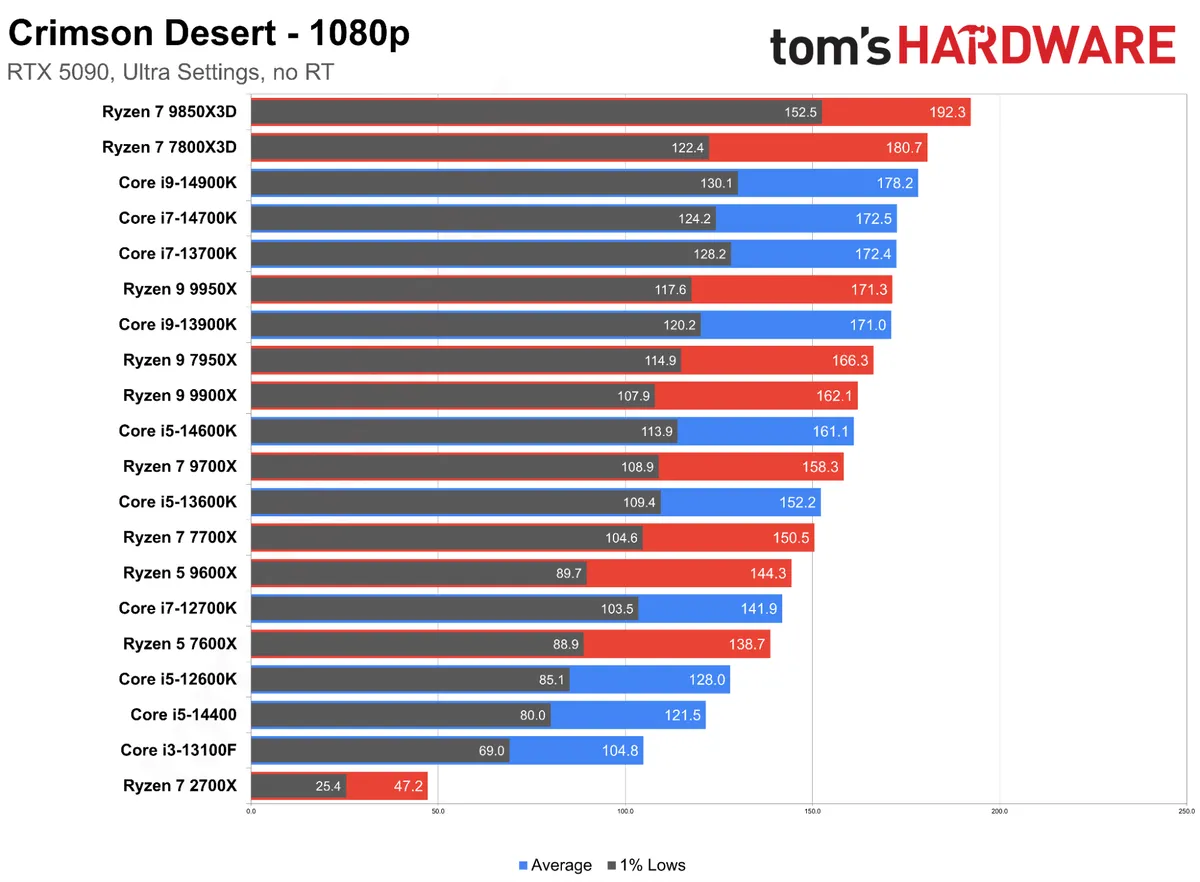
There’s a smooth gradient of performance from the top of the stack to the bottom, but somewhere in the range of a Core i5-14600K or Ryzen 7 9700X is the sweet spot. Past that point, we see much smaller jumps in performance. The Ryzen 9 9900X is only 2% faster than the Ryzen 7 9700X, and while the Ryzen 9 9950X is a solid 8% faster, it’s also twice as expensive.
On the Intel side of things, Raptor Lake stands out across both 13th- and 14th-Gen offerings. Alder Lake is a different story. The Core i5-13600K is 19% faster than the Core i5-12600K, and the Core i5-14600K is nearly 26% ahead. Similarly, you’re looking at around a 21% jump going from the Core i7-12700K to either the Core i7-13700K or Core i7-14700K.
In a surprise to nobody, AMD’s X3D offerings top the charts, though the margins aren’t as large as we’re used to seeing. The Ryzen 7 9850X3D is 7% ahead of the Ryzen 7 7800X3D, and the Core i9-14900K and Core i7-14700K aren’t far behind. More cache certainly helps, but BlackSpace looks optimized enough that cache misses aren’t completely killing performance.


On the other end of the spectrum, we have the Ryzen 7 2700X and Core i3-13100F. Pearl Abyss says you can get by with a Ryzen 5 2600X or Core i5-8500 for 1080p at 30 FPS, and you likely can — though, as the 1% lows show, you can expect some chopiness. Still, it’s shocking these CPUs hold up at all. It’s hard to overstate the scale of Crimson Desert, and even with these older, low-end chips, it doesn’t devolve into a stuttering mess along the lines of Dragon’s Dogma 2.
Looking at other metrics, the optimization underway in BlackSpace becomes clearer. In power, for instance, the load is modest. Even Intel’s Raptor Lake chips don’t crack 140W, while they can easily climb above 170W in a game like Starfield.
General impressions of Crimson Desert after testing

It was challenging to find a test scene for Crimson Desert. The game is large, for one thing, but more importantly, it’s varied. The performance window is fairly large. You'll see good performance standing alone on a mountainside, better performance in a room with a couple of NPCs, and worse performance in a town filled with dozens. You know the drill. There’s also loading and culling to deal with. Given the size of Crimson Desert and the speed at which you can traverse vast distances in some situations, you can immediately put a heavy load on your CPU. Even in these extreme cases, however, I encountered just minor hiccups in performance.
For testing, I used the first town you spot in Hernand, which is filled with at least several dozen NPCs on the streets and likely a hundred or more dotted throughout various buildings. Out in the open world, NPCs are more sparse, and naturally, the demand on your processor is lower. This was about as close as I could get to a stress test without hitting some massive loading zone that wouldn’t represent the moment-to-moment gameplay.
Although performance is understandably variable across different areas of the map, Crimson Desert glides to different performance targets, whereas most games stumble. The engine would much rather have pop-in than a stutter, which is probably something most players will agree with. Any stuttering I encountered was minor and quickly resolved, and it never showed up in an important gameplay moment.
BlackSpace is doing a lot, and if you pixel peep too closely, you’ll see the magic tricks unravel. It has a gritty, aggressive rendering style clearly meant for a TV more than a monitor sitting a foot away from you. That’s not a bad thing. If you look for every little rendering hiccup or aliased edge, you’ll see the sacrifices Pearl Abyss had to make to pull Crimson Desert off. Take in the full image, however, and you’ll be left with your mouth agape.
It’s not just the rendering that’s impressive. Crimson Desert is a systems-driven game, and you interact with everything. You won’t clip through an NPC if you run into them; you’ll crash into another solid being and get told off in response. If a vendor carrying a basket of apples or potatoes stumbles, their goods will tumble out in physics-driven glory. You can cut down just about any tree to gather wood, and hunt just about any animal for food. In one surprising moment, I was able to collapse an outlook where an archer was shooting at me by hacking away at the support beams. The game looks so beautiful that it’s easy to forget that the world reacts to your actions along the lines of Breath of the Wild or Tears of the Kingdom.
I have dozens of more hours I need to put into the game, but my early testing impressions are positive. This game is on my shortlist of new titles to add into our CPU game testing suite, but I want to see how players react to the game first. It scales well, and if the game is popular enough, it’ll likely show up in our suite before long.

Follow 3DTested on Google News, or add us as a preferred source, to get our latest news, analysis, & reviews in your feeds.