Why you can trust 3DTested Our expert reviewers spend hours testing and comparing products and services so you can choose the best for you. Find out more about how we test.
Even with the fumble of Arrow Lake, Intel has maintained compelling performance in applications. That upside was just heavily offset by slower gaming performance. Here, with the Core Ultra 7 270K Plus, the upside in applications is too big to ignore. You’re looking at chart-topping single- and multithreaded performance. That wouldn’t be surprising for a $500 to $600 flagship, as is the case with the Core Ultra 9 285K or Ryzen 9 9950X. But we’re talking about a mainstream $300 chip.
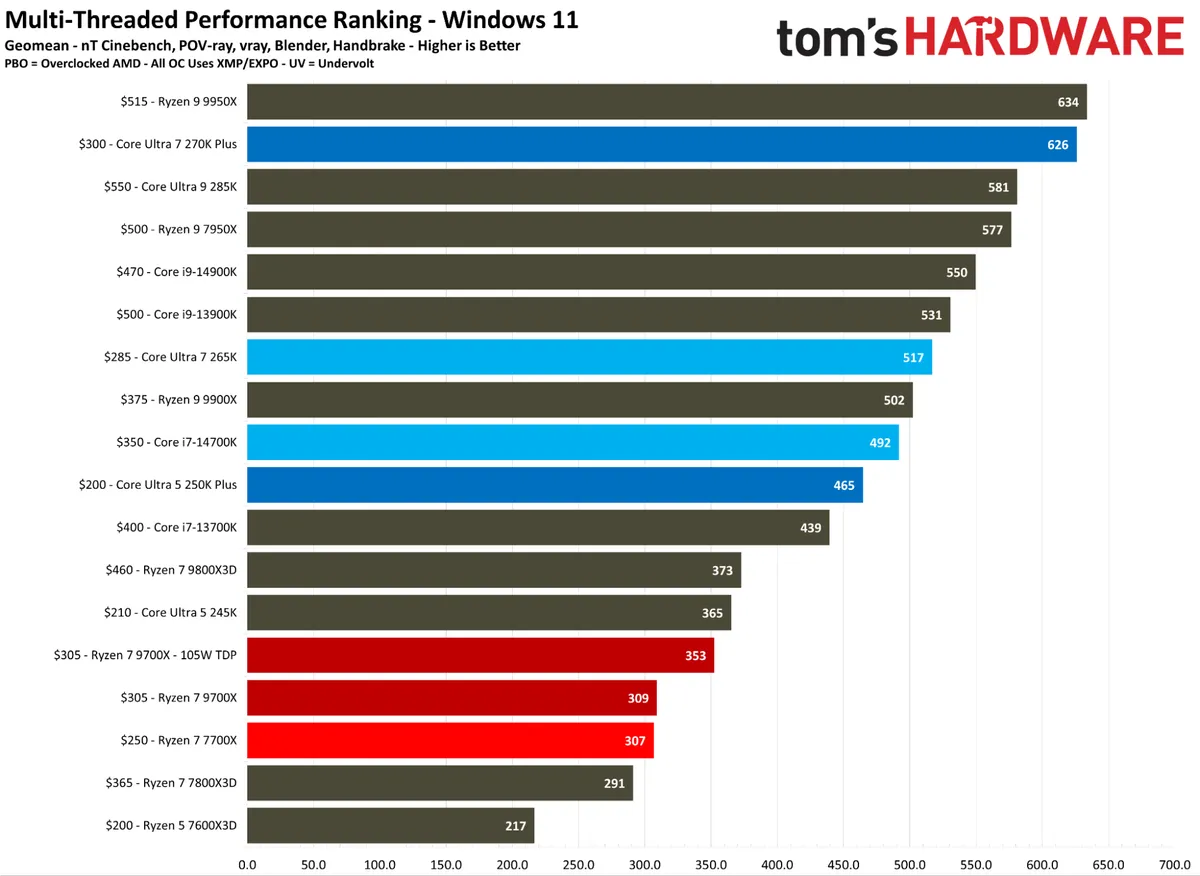
In multithreaded performance, there are sizable jumps, even compared to flagships. Compared to our top-performing chip, the Ryzen 9 9950X, the Core Ultra 7 270K is a mere 1.2% behind. Meanwhile, it’s 7.7% faster than the Core Ultra 9 285K, 21% ahead of the 265K, and 102% ahead of the Ryzen 7 9700X. Bumping to the Ryzen 7 9700X’s 105W TDP, the Core Ultra 5 250K Plus is 77% ahead.
Intel is undercutting its own flagship with the Core Ultra 9 285K, and apparently, that was the goal. Stock Arrow Lake chips will continue to exist in the market, likely at far reduced prices, but the Core Ultra 7 270K Plus claiming a new top slot for Intel isn’t an accident. It doesn’t claim the top slot in multithreaded performance overall, falling behind by just 1% compared to the Ryzen 9 9950X, but it also doesn’t demand a chart-topping price — nowhere close, in fact.
Hopefully, this doesn’t cause confusion in the market, with the Core Ultra 7 Plus clearly outperforming the Core Ultra 9. It depends on where prices end up once the launch dust has settled.

The Core Ultra 7 270K Plus does claim the top of the chart in single-threaded performance, however, outpacing the Core Ultra 9 285K by just 1.4%. Compared to the Core Ultra 7 265K, you’re looking at 3.3%, and against the Ryzen 7 9700X, Intel is ahead by 10%. Single-threaded performance was one of Arrow Lake’s few strong points, so it’s not surprising to see the Core Ultra 7 270K at the top of the pile here. You can see the 105W TDP mode for the Ryzen 7 9700X isn’t doing much here; the extra power only nets higher performance in heavily-threaded workloads.
Although the Core Ultra 7 270K Plus is impressive overall, the oddities of the Arrow Lake architecture still rear their ugly head in some workloads. The trend you can see in our geomeans plays out largely untouched, but there are a handful of workloads where the Core Ultra 7 270K Plus doesn’t improve on the 265K at all, and others where both chips are still behind Raptor Lake Refresh offerings like the Core i7-14700K.
Rendering Benchmarks


In Cinebench 2024, the Core Ultra 7 270K Plus is 8% ahead of the 285K and nearly 22% ahead of the Core Ultra 7 265K in the multithreaded test. Compared to AMD’s $300 Ryzen 7 9700X, the Core Ultra 7 270K is 115% ahead. In Blender, AMD’s 16-core chips still hold the crown, but the 270K Plus isn’t far behind, offering between a 22% and 26% uplift compared to the Core Ultra 7 265K and between a 96% and 110% improvement compared to the Ryzen 7 9700X.
We can see similar improvements in heavily-threaded renderers like POV-Ray and LuxMark, though the Core Ultra 7 270K Plus is less impressive in Embree. It’s particularly weak in OSPray Studio, as well, which is something we can see with every Arrow Lake chip. AMD and Intel’s Raptor Lake variations top the chart in this test.
Encoding Benchmarks


Encoding can be similarly threaded compared to renderers, though there’s greater room for single-threaded gains. In heavily-threaded video encoding via Handbrake, the Core Ultra 7 270K Plus is 13.6% ahead of the 265K in 10-bit x265 encoding, and 37% ahead with AV1, in both cases losing out marginally to the Ryzen 9 9950X. In these heavily-threaded encoding scenarios, the Core Ultra 7 270K is unsurprisingly impressive; it has 24 cores at its disposal, after all.
Single-threaded encoding is a slightly different story. In the Lame audio encoder, the Core Ultra 7 270K Plus allows Intel to outclass the Core i7-14700K, but it still falls short of the Raptor Lake Core i9s with their blistering clock speeds. Similarly, in a JPEG-XL decode on a single thread, the 270K Plus is only a minor 2% ahead of the 265K, and it’s nearly 7% behind the Ryzen 7 9700X.
Creator App Benchmarks


Creative apps like Adobe Premiere Pro contextualize some of these more specific encoding and rendering tests into applications with a varied workload on the CPU. In Photoshop, you see a clear split between AMD and Intel chips, and the Core Ultra 7 270K Plus can’t overcome that. It’s 4% ahead of the Core Ultra 7 265K, however, finally allowing Intel to claim a lead over its last-last-gen Core i7-14700K.
In Premiere Pro, the Core Ultra 7 270K claims the top of the chart, and it claims a top slot in DaVinci Resolve, as well. Particularly in Resolve, you can see this performance wall around 132,000 that the high-core-count flagships run into. Whereas the Core Ultra 7 265K was slightly behind this mark, in lockstep with the Core i7-14700K, the Core Ultra 7 270K Plus is able to hang with the top dogs.
Web and Office Benchmarks


A modern 24-core CPU isn’t going to run into issues with most modest web and office workloads, but there are a few benchmarks to draw attention to. In Procyon’s Excel test, the Core Ultra 7 270K Plus claims the top slot, outpacing the 265K by a decent 5%. In reality, though, most of these workloads aren’t taxing enough to fully leverage the CPUs in our test pool. If you look at the Word subtest, for example, the Core Ultra 7 270K is on top technically, but the Ryzen 7 9700X also outpaces both the Core i9-14900K and Core i9-13900K.
Compilation, Chess Engines, Security, Compression, and Other Benchmarks


In addition to our main rendering, encoding, creative, and office benchmarks, we have a large suite that fits firmly in the “other” category. These are still important workloads, but they’re more specific and don’t apply universally when looking at overall CPU performance. Starting off, we have code compilation, where the 24-core array available to the Core Ultra 7 270K Plus really shines. It tops the charts using the LLVM compiler, completing the compile 15% faster than the 265K and 48% faster than the Ryzen 7 9700X.
In chess engines, the Core Ultra 7 270K Plus earns the top slot in Leela Chess Zero, and it’s able to keep pace with the flagships in Stockfish 9 and asmFish. In NAMD, the Core Ultra 7 270K Plus also claims the top slot, speeding up a molecular dynamics simulation by 13% compared to the 265K, 34% compared to the Core i7-14700K, and 65% compared to the Ryzen 7 9700X.
Y-Cruncher, which calculates to a specified digit of Pi, heavily favors AMD’s Zen 5 CPUs. This benchmark can leverage AVX-512 instructions, which gives Zen 5 chips a huge advantage. The Core Ultra 7 270K Plus helps close the gap a bit, but AMD is going to dominate this test for as long as it has a monopoly on AVX-512 in consumer chips.
AMD also holds the edge in compression workloads, though Intel is able to reclaim some performance slots in decompression tests, particularly in unpacking Firefox and the Linux Kernel. The other benchmark to draw attention to is SQLite with maximum threads. As you can see, all Arrow Lake chips failed this test, including the Core Ultra 7 270K Plus. I’m not sure why that’s the case, but I suspect it has something to do with a lack of Hyper-Threading and Intel’s hybrid architecture.
Geekbench 6 Benchmarks


Geekbench isn’t tallied in our geomeans you can see above, and that’s because it isn’t actually a workload. It’s a pure benchmark, built to simulate different workloads but not actually running them. We normally don’t draw too much attention to Geekbench, but it’s worth highlighting here due to the boost it sees with iBOT.
Intel calls this a “proof of concept,” and it was very clear in materials shared with reviewers that this performance doesn’t extend out to the workloads Geekbench represents. It’s just a showcase of what iBOT could potentially do in non-gaming applications in the future. The company tells me it’s very cognisant of not trying to game the system with specific benchmark optimizations. The results above are purely academic, and in the context of iBOT. You shouldn’t expect them to extend out.
In that context, there’s a lot of promise here. The Core Ultra 7 270K unsurprisingly tops the charts, and by a decent margin across the board. If Intel is able to deliver this type of margin in a real application, not a pure benchmark, the possibilities with iBOT open up greatly.
SPECWorkstation 4 Benchmarks


Rounding out our application tests is SPECWorkstation 4, which covers a lot of the benchmarks we already run, just in a single test suite. SPEC runs a lot of highly specific workloads, from creative apps to financial models to data science workloads. We’re not going to retread water here, but feel free to look over our results if you’re concerned about a particular workload.
- MORE: Best CPU for gaming
- MORE: CPU Benchmark Hierarchy
- MORE: Intel vs AMD
- MORE: How to Overclock a CPU