Why you can trust 3DTested Our expert reviewers spend hours testing and comparing products and services so you can choose the best for you. Find out more about how we test.
Intel focused heavily on gaming with the announcement of Core Ultra 200S Plus CPUs, and for good reason. Gaming was undoubtedly the weakest point for Arrow Lake chips, with Raptor Lake options (both 13th- and 14th-Gen) offering clearly better performance. Add on top of that AMD’s dominating lead in gaming with the Ryzen 7 9800X3D, and now the Ryzen 7 9850X3D, and it’s clear why Intel focused on gaming as much as it did. It needs to stem the bleeding.
And it has vastly improved gaming performance, at least to the point where the Core Ultra 7 270K Plus is competitive in its price bracket. Our test results are solid, though they aren’t quite as rosy as Intel’s claims. Before digging in, note that we tested with an RTX 5090 FE to isolate CPU performance as much as possible, and performance will vary with lesser cards and different fidelity settings. We tested at 1080p without upscaling and used a combination of High and Ultra graphics settings. You can find a full breakdown of our test system at the end of this review.
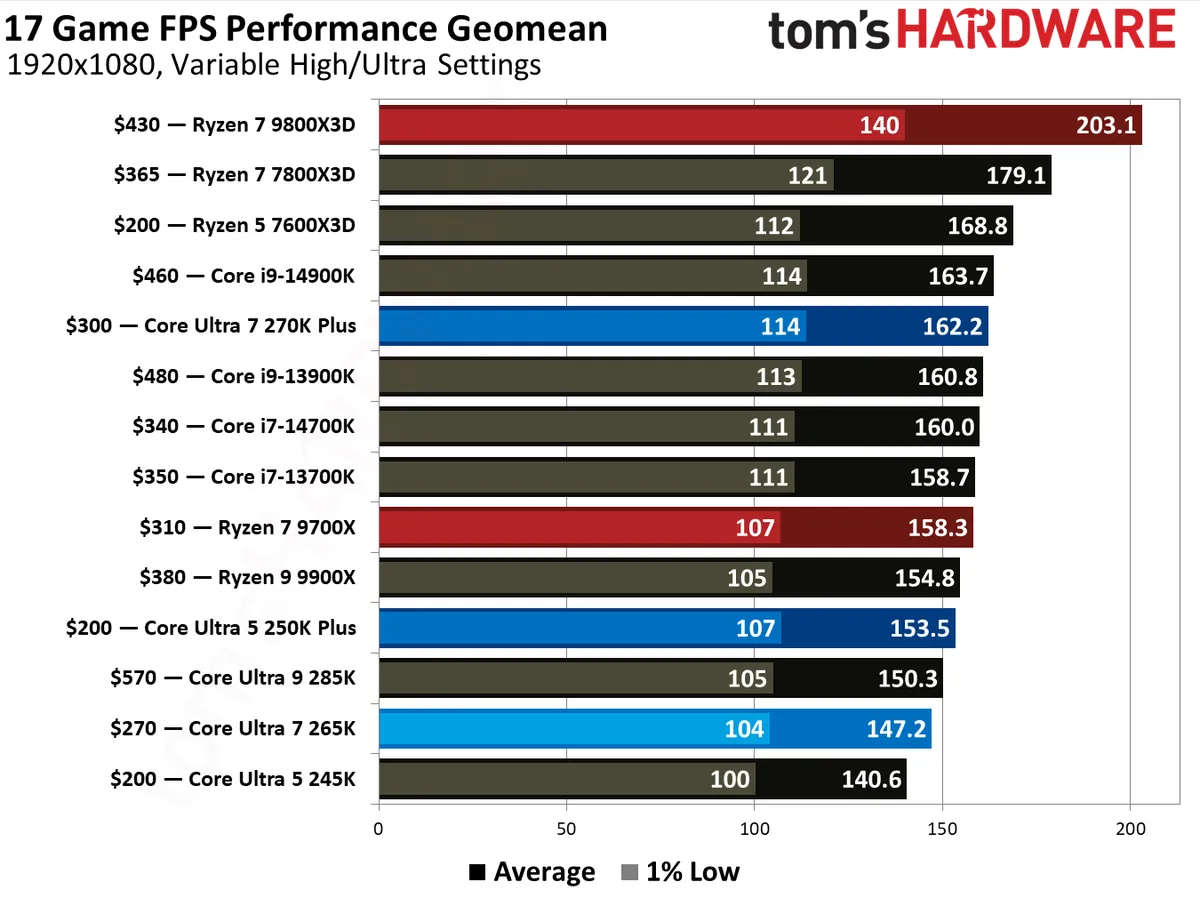
Intel claims the Core Ultra 7 270K Plus is within 10% of the Ryzen 7 9800X3D and 15% faster than the Core Ultra 7 265K. My results are different. With the 17-game test suite I looked at, the 270K Plus was 20% slower than the Ryzen 7 9800X3D and 10% faster than the 265K. The swing likely has to do with iBOT. Although I tested with iBOT on, I didn’t include games that aren’t normally a part of my test suite just because they have iBOT optimizations.
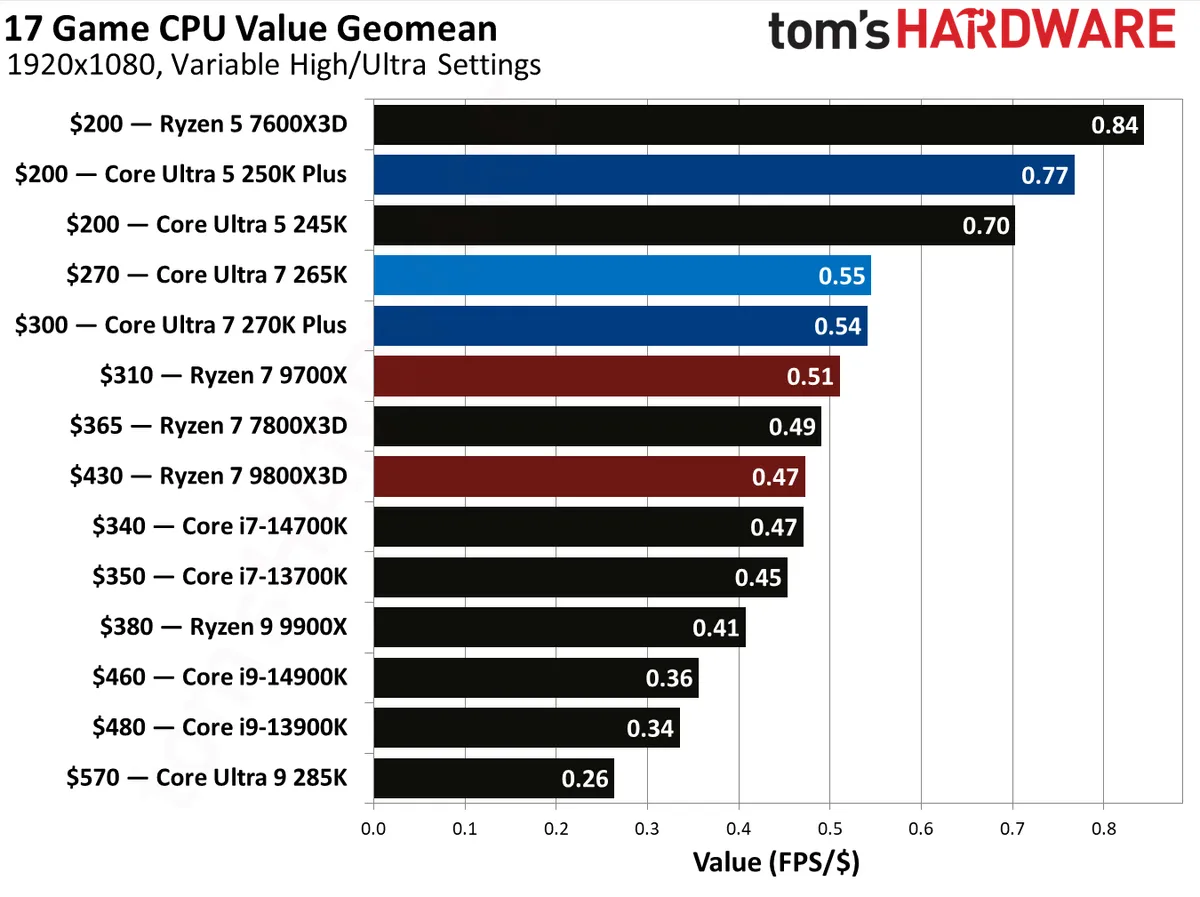
Although the Ryzen 7 9800X3D claims a dominating lead, it’s also at least $130 more expensive than the Core Ultra 7 270K Plus, and at most $180 more expensive. The more apt comparison is to the Ryzen 7 7800X3D, which is available for around $365. AMD’s chip is 10% faster while being nearly 22% more expensive. The Ryzen 5 7600X3D blows that value equation out of the water, however, offering 4% higher gaming performance for $100 less, if you have a Micro Center nearby.
Gen-on-gen, the comparisons aren’t great for Intel. After three years, the Core Ultra 7 270K Plus is just marginally ahead of the Core i7-14700K, and would almost certainly be behind without the iBOT assistance. Even with iBOT, the Core Ultra 7 270K Plus can't overcome the Core i9-14900K, which remains Intel's fastest gaming CPU.
The 270K Plus is cheaper than what the Core i7-14700K demands right now, and far cheaper than trying your hand with a Raptor Lake chip via third-party sellers; new 13th-Gen inventory has dried up.
The $200 Core Ultra 5 250K Plus is delivering close to 95% of the gaming performance of the Core Ultra 7 270K Plus, all while shaving a third off the price.


Outside of frame rates, the Core Ultra 7 270K Plus consumes more power than the Core Ultra 7 265K, and ends up less efficient as a result. AMD still dominates in efficiency, particularly with any of its X3D offerings. Although the 270K Plus represents nearly a 26% jump in power consumption compared to the 265K, it’s still not as power hungry as Intel’s Raptor Lake offerings. And, despite such a large increase in power consumption, the 270K Plus didn’t run hotter than the 265K.
Taking price into consideration, the Core Ultra 7 270K Plus delivers about the same value as the Core Ultra 7 265K, at least at the latter’s now-discounted price. It’s ahead on value compared to the Ryzen 7 9800X3D and Ryzen 7 9700X by a bit, but the Ryzen 5 7600X3D with its $200 price tag really runs away with overall gaming value.
A Plague Tale: Requiem Benchmarks – Intel Core Ultra 7 270K Plus


Starting off with A Plague Tale: Requiem, it’s one of the weaker outings for the 270K Plus. It’s about 3% behind the Ryzen 7 9700X (though with better 1% lows), and 9.4% behind the Core i7-14700K. There’s a respectable 8.2% uplift compared to the Core Ultra 7 265K, but it’s nowhere close to enough to overcome the competition.
Baldur’s Gate 3 Benchmarks – Intel Core Ultra 7 270K Plus


The Core Ultra 7 270K Plus fares better in Baldur’s Gate 3, though it still falls a touch short of the Core i7-14700K and Core i7-13700K. It leads the Ryzen 7 9700X by a marginal 2.4%, and outclasses the Core Ultra 7 265K by 7.4%. But it’s 33% slower than the Ryzen 7 9800X3D, and 14% slower than the Ryzen 5 7600X3D.
Counter-Strike 2 Benchmarks – Intel Core Ultra 7 270K Plus


In a latency-sensitive game like Counter-Strike 2, the Core Ultra 7 270K Plus looks better. This is the first game where it manages to beat the Core i7-14700K, though by less than half a point. There’s an 8.6% uplift compared to the Core Ultra 7 265K, which is a solid jump. As you can see from this chart, however, there’s a performance wall most chips hit around 660 FPS, which only the eight-core X3D chips are able to overcome.
Cyberpunk 2077 Benchmarks – Intel Core Ultra 7 270K Plus


Cyberpunk 2077 is the first game where we can see iBOT in action, and the results are interesting. Once again, we’re seeing only a negligible improvement over the Core i7-14700K. However, the 270K Plus manages an improvement of 7.8% compared to the 265K, and a 9.7% jump compared to the 9700X.
Doom: The Dark Ages Benchmarks – Intel Core Ultra 7 270K Plus


The Core Ultra 7 270K Plus tops the charts in Doom: The Dark Ages, but the victory is hollow. You can see a clear performance wall that these chips hit around 200 FPS, flattening our scaling. Flipping over to the efficiency chart, you can see that, although Intel is able to match AMD here in performance, Team Red is able to do so while consuming far less power.
F1 24 Benchmarks – Intel Core Ultra 7 270K Plus


F1 24 was one of the weakest showings of Arrow Lake CPUs initially, and the Core Ultra 7 270K Plus doesn’t change that story. The 270K Plus is nearly 10% ahead of the 265K, but otherwise, the Arrow Lake lineup makes up the bottom of our chart. It’s 13% slower than the Ryzen 7 9700X, and a massive 37% slower than the Ryzen 7 9800X3D.
Far Cry 6 Benchmarks – Intel Core Ultra 7 270K Plus


Far Cry 6 is another game with iBOT support, and it’s the most impressive showing of the Core Ultra 7 270K Plus we’ve seen so far. It can’t touch AMD’s X3D offerings, which perform particularly well in this game, but there’s a 5% jump over the Core i7-14700K and Ryzen 7 9700X, and an impressive 21% improvement compared to the Core Ultra 7 265K.
Final Fantasy XIV Benchmarks – Intel Core Ultra 7 270K Plus


Final Fantasy XIV is another game that loves X3D chips, and it’s another game with iBOT support. Here, iBOT is allowing Intel to push past a performance wall and get into the conversation with AMD’s stock Zen 5 competition. It matches the Ryzen 7 9700X and offers a massive 35% uplift over the Core Ultra 7 265K.
Flight Simulator 2024 Benchmarks – Intel Core Ultra 7 270K Plus


Flight Simulator 2024 isn’t as skewed toward X3D as Final Fantasy XIV and Far Cry 6, allowing the Core Ultra 7 270K Plus to claim a lead over the Ryzen 7 7800X3D for the first time. The margins are tight across the board here, though. The Core Ultra 7 270K Plus is just 4% ahead of the Ryzen 7 9700X and 7% ahead of the Core Ultra 7 265K.
Hitman 3 Benchmarks – Intel Core Ultra 7 270K Plus


Hitman 3 has iBOT optimizations, and that gives the Core Ultra 7 270K Plus a large advantage in this game. It’s ahead of the Core i7-14700K by 5.2%, and it outclasses the Ryzen 7 9700X by 15%. Compared to the Core Ultra 7 265K, the uplift is 20%. This game is probably the clearest proof that iBOT has legs, given there are enough games that can see this level of post-launch optimization.
Hogwarts Legacy Benchmarks – Intel Core Ultra 7 270K Plus


Doubling down on the iBOT narrative is Hogwarts Legacy, where the Core Ultra 7 270K Plus cleanly beats the Ryzen 7 7800X3D and beats the Core i7-14700K by 7.8%. Similar to Hitman 3, Intel’s latest chip offers close to a 15% improvement over the Ryzen 7 9700X and a 17% jump over the Core Ultra 7 265K.
Minecraft RTX Benchmarks – Intel Core Ultra 7 270K Plus


Minecraft is unironically one of the most demanding games in our test suite due to setting an unreasonable render chunk distance of 96; an option that isn’t even available if you don't have at least 32GB of memory. Arrow Lake chips have always struggled in this benchmark, and the Core Ultra 7 270K Plus falls into the same trappings.
Monster Hunter Wilds Benchmarks – Intel Core Ultra 7 270K Plus


Oblivion Remastered Benchmarks – Intel Core Ultra 7 270K Plus


Oblivion Remastered is a new addition to our test suite, mainly due to the fact that it’s built on Unreal Engine 5. Overall performance is basically a flat line, but the Core Ultra 7 270K Plus offers a solid 18% improvement in 1% lows compared to the Core Ultra 7 265K, allowing Intel to achieve the smoothness offered by the Raptor Lake and Zen 5 competition.
Marvel’s Spider-Man 2 Benchmarks – Intel Core Ultra 7 270K Plus


The Core Ultra 7 270K Plus performs well in Marvel’s Spider-Man 2, even without the iBOT assist. It matches the Ryzen 7 7800X3D, marginally outclasses the Core i7-14700K, and manages to beat the Ryzen 7 9700X by 8.3%. It still sits behind the Raptor Lake i9s, but those chips are also much more expensive, even years after release.
Starfield Benchmarks – Intel Core Ultra 7 270K Plus


The Last of Us Part One Benchmarks – Intel Core Ultra 7 270K Plus


Rounding out our gaming tests is The Last of Us Part One, which is one of the best showings for the Core Ultra 7 270K Plus without iBOT. It matches the Core i9-14900K and Ryzen 7 7800X3D while offering a 7.3% jump over the Core Ultra 7 265K and a 12.4% improvement over the Ryzen 7 9700X.
- MORE: Best CPU for gaming
- MORE: CPU Benchmark Hierarchy
- MORE: Intel vs AMD
- MORE: How to Overclock a CPU