Why you can trust 3DTested Our expert reviewers spend hours testing and comparing products and services so you can choose the best for you. Find out more about how we test.
With 18 cores at its disposal, it’s no surprise that the Core Ultra 5 250K Plus shines in heavily-threaded applications. Not all of those cores are built equally, mind you, but Intel’s new entry-level chip manages to pull off some impressive rankings nonetheless. It’s competing with previous-gen Intel chips that launched at twice the price, and outclassing everything AMD currently has to offer below $400.

Looking at our multithreaded geomean, it’s a blood bath compared to AMD. The Ryzen 5 9600X, with its six cores, can’t come remotely close to the Core Ultra 5 250K Plus. Intel’s chip is nearly 79% faster, and even when juicing the 9600X with its optional 105W TDP mode, the dynamic between the two barely changes. The four extra E-cores pull their weight against the 245K, as well, with the 250K Plus managing a 27% lead over its predecessor.
Although you have a massive core array on the Core Ultra 5 250K Plus, AMD is able to get further with fewer “full” cores. The 250K Plus is about 7% behind the Ryzen 9 9900X. That CPU costs about twice the price, however, showcasing how much Intel is squeezing out of the Arrow Lake architecture at this price. For $200, there isn’t another CPU remotely close to the performance of the 250K Plus in heavily-threaded applications. Even CPUs north of $300 can’t keep up.

In single-threaded performance, the Core Ultra 5 250K Plus manages just a 1.5% improvement over the Core Ultra 5 245K. There aren’t big core clock jumps here, so I never expected to see a large increase in performance. And, Intel already held a solid lead in single-threaded performance with Arrow Lake.
Again, the price is what matters here. With the 245K, Intel was competing with the Ryzen 7 9700X and coming out just marginally ahead in application performance. With a small bump in performance and a big reduction in price, the Core Ultra 5 250K Plus is now competing against the Ryzen 5 9600X, and coming out with a solid 6% lead.
Rendering Benchmarks


Rendering is a heavily-threaded workload in most cases, and the four extra E-cores on the Core Ultra 5 250K Plus allow it to claim solid ground ahead of both the competition and Intel’s previous offerings. In Cinebench 2024, it’s ahead of the 245K by 25%, the Core i5-14600K by 34%, and the Ryzen 5 9600X by 91%. Even jumping to the 9600X’s 105W mode, the Core Ultra 5 250K Plus maintains an 82% lead.
The same is true in POV-Ray, with the Core Ultra 250K Plus more than doubling the performance of the 9600X in both power modes, and improving upon the Core Ultra 5 245K by nearly 19%. Similar situations play out in Corona, LuxMark, and V-Ray. Intel is doubling ( sometimes more than doubling) the performance of AMD’s competing six-core part and offering generational-like improvements over the 245K.
Blender is another app where the Core Ultra 5 250K Plus shows similarly dominant performance. It’s not quite twice as fast as the Ryzen 5 9600X, but it’s close. Compared to the Core Ultra 5 245K and Core i5-14600K, the 250K Plus is in the range of 30% to 31% ahead, depending on the scene you look at.
On the single-core front, the Core Ultra 5 250K Plus holds its own, but the margins are unsurprisingly thinner. POV-Ray is perhaps its best showing in a single-core render, offering a slight 5.7% bump over the 245K and nearly a 33% jump compared to the 9600X.
Encoding Benchmarks


The Core Ultra 5 250K Plus is similarly strong in encoding workloads, which are typically heavily threaded, as well. In Handbrake, the Core Ultra 5 245K and Core i5-14600K mostly matched each other, but the 250K Plus offers a lead of 23% to 29%, depending on the codec used. Compared to the Ryzen 5 9600X, the 250K Plus leads by between 34% and nearly 77%, depending on the codec. That’s even true with the 9600X running at its 105W TDP.
The results are less impressive in audio encoding, with the Core Ultra 5 250K Plus matching the 245K in a WAV-to-FLAC encode and actually falling a touch short in a single-threaded LAME run. The only test where AMD comes out slightly ahead is our extended LAME run, though encoding an mp3 is a lightweight task for any of the CPUs in our test pool.
Creator App Benchmarks


When you get down to around $200, you start to run into issues in more demanding creator apps like DaVinci Resolve and Premiere Pro. The Core Ultra 5 250K Plus is offering near-flagship performance in these apps, however. In Resolve, it’s around 6% ahead of both the Core i5-14600K and Core Ultra 5 245K overall. Compared to the Ryzen 5 9600X, it’s 18% ahead. Its closest company in terms of score here are Core i7s and Ryzen 9s, which is quite the feat for a $200 processor.
In Premiere Pro, the Core Ultra 5 250K Plus matches the Core Ultra 9 285K, beating out both the Ryzen 9 9900X and Core i7-14700K. Intel chips usually excel in Premiere Pro, so it’s not surprising to see the 250K Plus continue that trend. Still, it’s close to 9% ahead of the Ryzen 5 9600X, and matches the performance of flagship CPUs.
On the flip side, AMD dominates in Photoshop. Unless you’re handling an extremely complex project, Photoshop is less demanding on your system than Premiere Pro and Resolve. Regardless, the 250K Plus is around 7% ahead of the Core i5-14600K and Core Ultra 5 245K and 10% behind the Ryzen 5 9600X.
Web and Office Benchmarks


Web and office workloads aren’t going to tax most modern CPUs, so it’s not surprising that there’s a thin window of scaling in our test pool. The Core Ultra 5 250K Plus generally leads the Ryzen 5 9600X, and it either matches or slightly exceeds the Core Ultra 5 245K. The Core i5-14600K failed the Microsoft Office suite of tests via Procyon, so although it’s included on the charts, there is no result. Rest assured, the Core i5-14600K has no issues running Word, Excel, or Powerpoint, but we didn’t have time to troubleshoot the failure through Procyon in time for this review.
Compilation, Chess Engines, Security, Compression, and Other Benchmarks
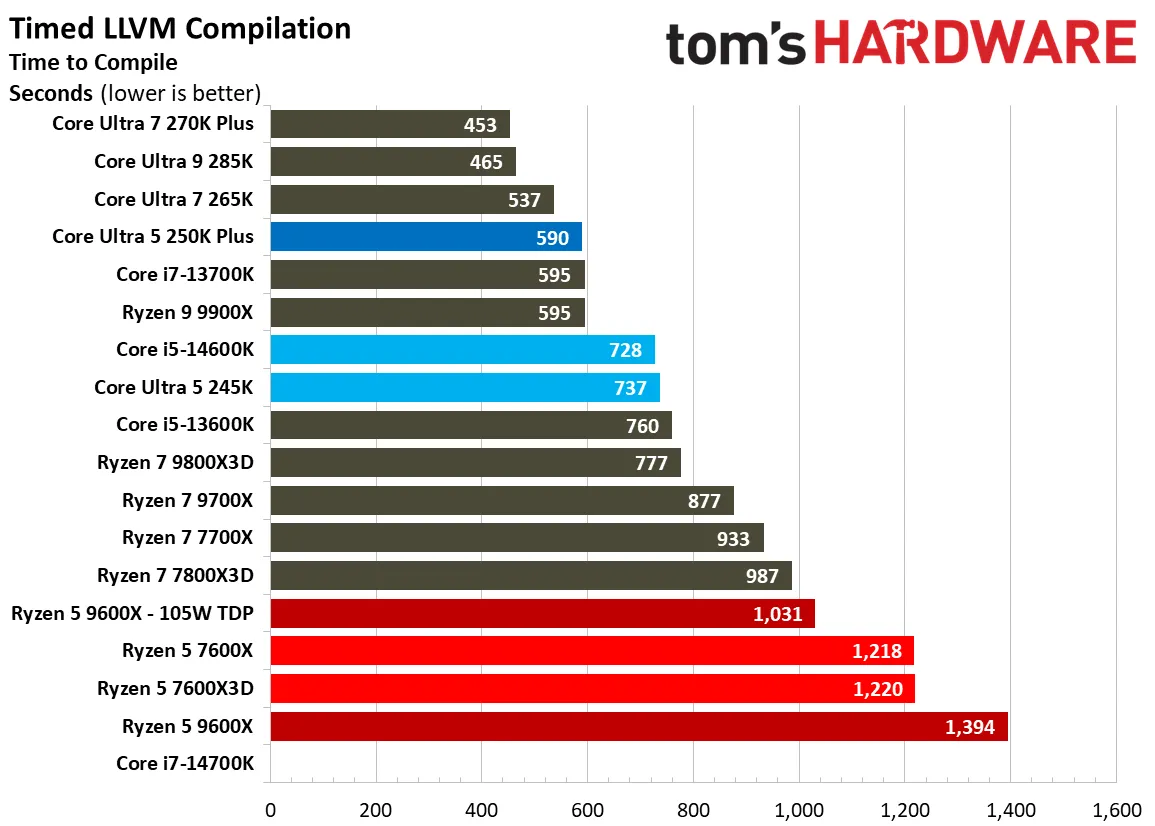
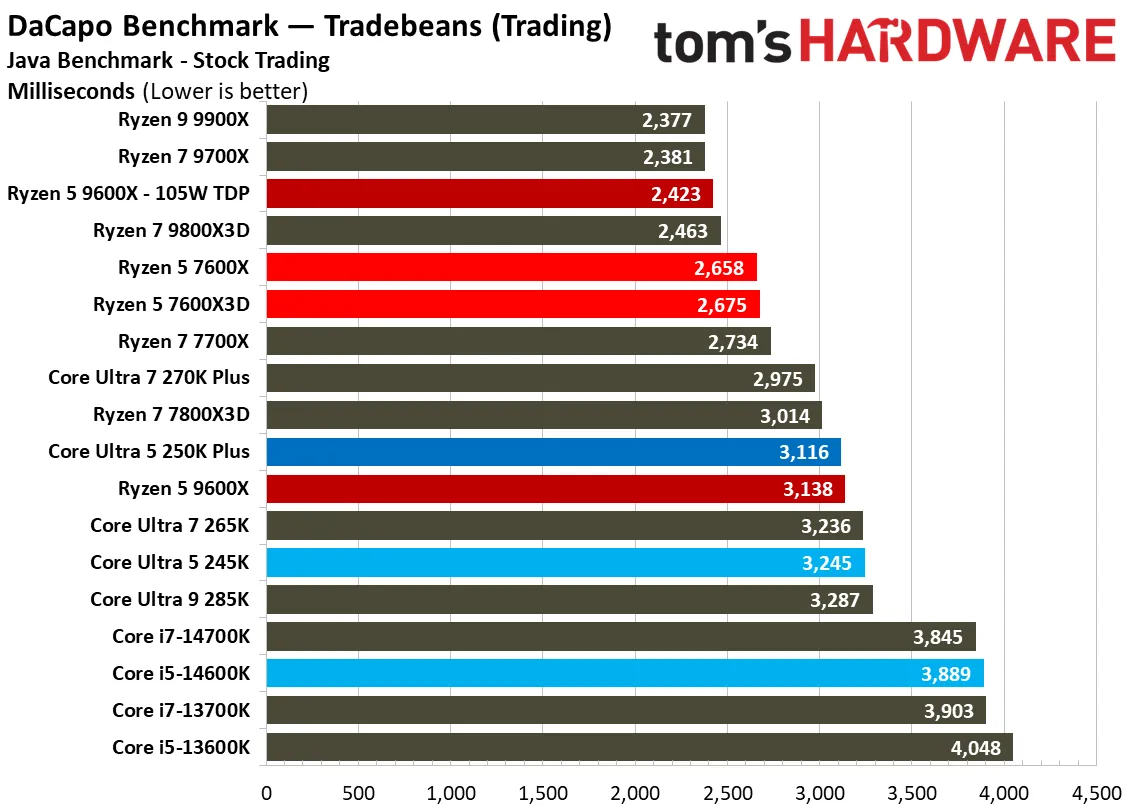


Outside of our main encoding, rendering, and office workloads, we run a multi-hour suite of highly targeted benchmarks ranging from code compilation to encryption to NES emulation. Because the workloads are so varied here, you’ll see some jumping around in the rankings. For instance, in Y-Cruncher, we’re showcasing AVX-512 instructions in action. Zen 5 CPUs support AVX-512 with a 512-bit data path; Arrow Lake and older Raptor Lake chips don’t.
One test to draw attention to is SQLite. All of the Arrow Lake chips we tested failed on the maximum threads test. There’s something wrong with Arrow Lake here. They fail consistently, and even with the latest set of drivers and microcode from Intel.
Geekbench 6 Benchmarks


We don’t normally segment out Geekbench results. It doesn’t factor into our overall geomean because it’s a pure benchmark, not a real workload. We run it because it’s popular, and you’ll find it almost universally in reviews. We’re highlighting it here because the Core Ultra 5 250K Plus is getting a boost from iBOT in Geekbench.
Intel calls this a “proof of concept,” and it has been clear that the performance improvement in Geekbench doesn’t extend to the workloads it represents. The results here are purely about evaluating the potential of iBOT, not the performance of the Core Ultra 5 250K Plus across a broad range of workloads.
In that context, the results here are impressive. Right now, Intel is only applying iBOT to games, but it should work just as well in applications. Geekbench is low-hanging fruit to demonstrate that capability. Hopefully, we’ll see some application updates to iBOT in the future to see how it fares in a real workload.
SPECWorkstation 4 Benchmarks


Rounding out our application benchmarks is SPECWorkstation 4. A lot of the tests in the SPEC suite mirror tests we already run, but it’s a one-stop shop for a ton of workloads and some more specific tests we don’t have great benchmarks for. We’re including the data here for reference, but SPEC doesn’t factor into our overall geomeans.
- MORE: Best CPU for gaming
- MORE: CPU Benchmark Hierarchy
- MORE: Intel vs AMD
- MORE: How to Overclock a CPU