A set of Harvard engineers have succeeded in achieving a new milestone for both 3D printing and soft robotics. A new 3D printing technique, developed by the team, allows for the creation of fully flexible 3D printed structures that can twist and change shape on demand.
This new technique, developed by former postgraduate student Natalie Larson and graduate student Jackson Wilt at the John A. Paulson School of Engineering and Applied Sciences, merged several existing methods to create a new method called rotational multi-material 3D printing. This technique prints multiple materials through a single nozzle, which is continuously rotating as it prints.
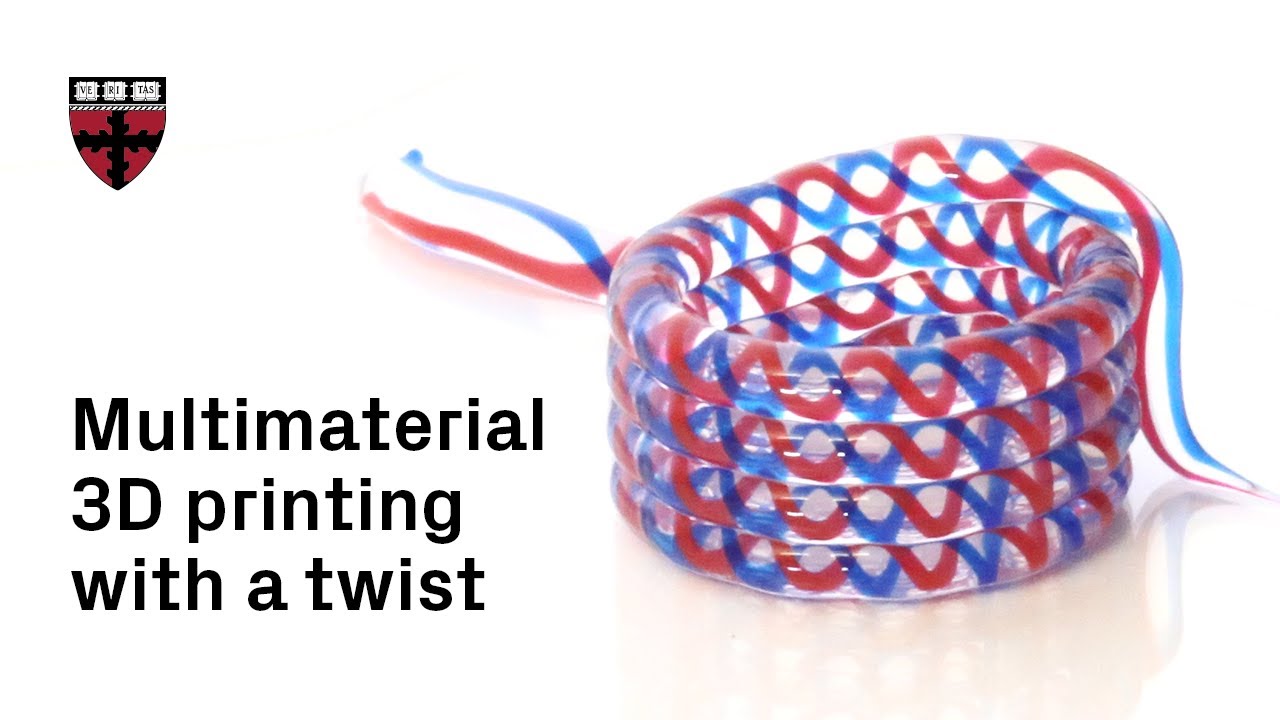
This method allows the team to determine how the materials combine in structure as it prints with precision by adjusting the nozzle's design, rotation speed, and flow rate. The strong outside layer, which is formed from a durable polyurethane, protects the poloxamer interior, described as a hair gel-like polymer substance. Once the print is complete, the gel is washed out to leave a series of hollow tubes that can be manipulated to act as muscles, pressurized with air or fluid to move them in different ways.
Article continues belowThe complexity of the design even allows for built-in motion logic — the structure can be designed to bend or twist predeterminately. According to Wilt, this is completed by using two materials that can be "rotated to program the direction the robot bends when inflated." The researchers used a flower-like spiral actuator, unfurling when it's inflated, along with a hand-like gripper with fingers that can curl around an object, to demonstrate its success.
Assuming the process can be used on an industrial scale, there are two huge advantages to this kind of 3D print design for soft robotics: speed and simplicity. Traditionally, soft robots have involved casting soft materials into a mold and encapsulating them together, layer by layer. Rather than relying on this time-consuming process, requiring lots of individual components and sections, a 3D printer could complete a complex, malleable structure in a single print and program movement logic directly within it.
Larson and Wilt's efforts could easily revolutionize the field of robotics and have an impact on a range of industries — if they can get it off the ground. Their work, which has been published in the Advanced Materials journal, is now subject to a filed patent.

Follow 3DTested on Google News, or add us as a preferred source, to get our latest news, analysis, & reviews in your feeds.